


The load angle in an armrest test is 10° from vertical. Not “roughly 10°,” not “about a hand’s width of lean.” It is 10°, because that is the angle the standard defines — and because a few degrees of drift quietly changes the test into one nobody specified. An armrest durability and cyclic bending tester earns its keep by holding that angle mechanically instead of trusting an operator’s eye.
The angle is the specification
A cyclic side load applied at 10° from vertical is not an arbitrary lean. It reproduces the way a user pushes sideways and downward on an armrest at once — rising from the chair, or bracing to stand. If the bench delivers 12° or 8°, it is loading the armrest through a different force vector, and the 60,000-cycle result no longer corresponds to the standard’s intent.
This is the difference between a test and a demonstration. A demonstration shows the armrest bending; a test shows it bending under a defined, repeatable load. The 10° from vertical angle is where that line is drawn, and it is drawn in metal, not chalk.
How the machine locks the angle
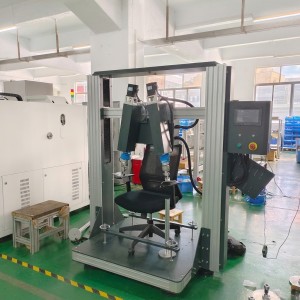
The bench drives a pneumatic cylinder through a swivel pivot that gives 500–900 mm of reach, so the same rig covers compact task chairs and executive chairs alike. The Ø50 mm cylinder presses a 100 mm wide loading pad against the armrest at the inclined contact angle — held mechanically by the pivot geometry, not re-set by hand between cycles.
Three things keep the test reproducible:
- A precision manual pressure regulator holds the cylinder output stable, with the force value shown digitally, so the load does not creep over 60,000 cycles.
- A fixed 10° contact geometry means the angle survives a thousand re-clampings of different chairs.
- An RPM readout with continuous adjustment lets the operator set and hold the cycle speed the standard requires, rather than estimating it.
Three tests, one bench
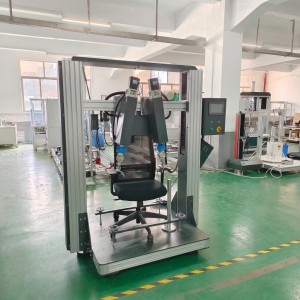
By re-orienting the cylinder output direction, the same platform performs three distinct load cases, replacing several single-purpose rigs:
| Test | What it applies | What it exposes |
|---|---|---|
| Armrest cyclic durability | Repeated 10° side load | Fatigue at the armrest attachment and pivot |
| Front edge static load | Sustained force on the armrest front | Local strength at the leading edge |
| Alternating bending (cyclic flexure) | Repeated flex in opposing directions | Stress reversal where a single-direction test would not fail the part |
The last row is the one a single-purpose fatigue rig misses. Alternating bending reverses the load, and materials fail under reversal at stresses far below what one-direction cycling would suggest. A chair that passes 60,000 one-way cycles can still crack under flexure reversal — which is why the standards call for it as a separate clause.
What the standards frame
The loading conditions come from QB/T 2280-2016, BIFMA X5.1-2017, EN 1335:2000 and QB/T 2602-2013. QB/T 2280 and BIFMA X5.1 define the office-chair armrest fatigue and front-edge conditions; EN 1335 adds the European durability frame; and QB/T 2602 covers public-seating armrest loads, including lateral and downward static cases. A bench that maps all four covers the domestic, North American and European routes with one dataset.
For a Lituo machine aimed at export work, the practical question is whether the angle and force stay reproducible across that whole range of chairs. That reproducibility — not the cylinder’s raw power — is what turns a cycle count into a defensible result.
Why does the 10° angle matter so much?
Because it is the defined load vector of the standard. A few degrees of drift changes the force distribution on the armrest, so the result no longer corresponds to what the standard specifies.
What is the difference between cyclic durability and alternating bending?
Cyclic durability repeats a one-direction load; alternating bending reverses it. Materials fail under reversal at lower stresses, so the two are tested as separate clauses.
Can one bench really cover all three tests?
Only if the cylinder output can be re-oriented and the load angle held mechanically. A bench built for one direction cannot reproduce the others faithfully.
Which standards should I reference?
QB/T 2280-2016 and BIFMA X5.1-2017 for office-chair armrests, EN 1335:2000 for Europe, and QB/T 2602-2013 for public-seating armrest loads. Confirm the current edition before specifying limits.
Post time: Nov-06-2026


