


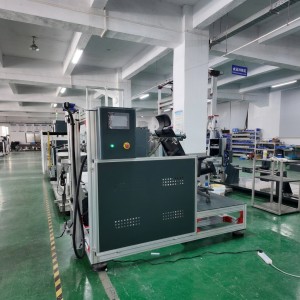
A chair that survives a hundred thousand fatigue cycles can still fail the moment a heavy user pushes down hard on one armrest to stand. Strength and durability are different questions, and a chair can pass one while failing the other. A backrest and armrest strength tester exists to answer the strength question — and it answers it along two axes at once.
Strength is a single, deliberate overload
Where a fatigue test applies a modest load thousands of times, a strength test applies a large load once, or a few times, and asks whether the part survives intact. The load represents normal use and deliberate misuse together — a user standing by pressing on the armrest, or a user leaning back hard against the backrest. Both are static load conditions, and both are judged on a single criterion: no fracture, no permanent deformation, no loss of function.
The distinction from durability is not pedantry. A repetitive load finds fatigue cracks that grow slowly; a strength test finds the one overload that snaps a bracket immediately. A manufacturing line that skips strength testing ships chairs that pass endurance yet shatter on first misuse.
Armrests fail along two axes
The armrest is loaded in two directions because it breaks in two directions. A vertical load reproduces a user pushing down to rise from the chair — the load that tests the armrest’s column, its height-adjustment mechanism, and its attachment to the seat. A horizontal load reproduces leaning sideways or pushing outward — the load that tests the same attachment in a direction it was rarely designed for.
The same bracket that shrugs off a downward push can shear under a sideways one. This is why the standards specify the two directions as separate clauses rather than combining them into one “armrest test.” A bench that loads only vertically has measured half the armrest’s strength.
Backrests fail along an angle
The backrest is tested at defined angles because the force of a reclining user arrives off-axis. One test loads the backrest at a reclined angle, reproducing a user leaning back with body weight; another loads it nearer vertical, reproducing a user bracing upright. Each angle stresses a different combination of the backrest shell, its bracket, and the tilt mechanism behind it.
| Component | Load direction | What it exposes |
|---|---|---|
| Armrest | Vertical (downward) | Column, height mechanism, seat attachment |
| Armrest | Horizontal (side/outward) | Same attachment in a rarely-tested direction |
| Backrest | Reclined angle | Shell, bracket and tilt mechanism under body weight |
| Backrest | Near-vertical angle | Bracing load at a steeper angle |
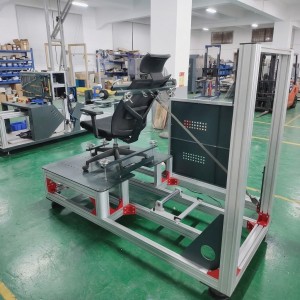
The point of a dedicated backrest and armrest strength tester is that all of these directions are applied through adjustable loading pads and re-orientable fixtures, so the operator loads the component along the axis the standard defines — not the axis that is easiest to set up.
What the standards frame
The loading conditions come from QB/T 2280-2016, BIFMA X5.1-2017 and EN 1335:2000. BIFMA X5.1 in particular separates the armrest strength clauses — vertical and horizontal — from the backrest strength clauses by type, because the failure modes are genuinely different. EN 1335 provides the European frame, and QB/T 2280 the domestic office-chair clause. A bench that maps all three produces one strength dataset covering the domestic, North American and European routes.
For a Lituo machine aimed at export work, the practical question is whether every axis — vertical, horizontal, and both backrest angles — is loaded to the defined direction, not just to whatever is convenient. That completeness is what separates a strength test from a strength demonstration.
Is strength the same as durability?
No. Strength applies a large load once or a few times and asks whether the part survives; durability repeats a modest load thousands of times. A chair can pass one and fail the other.
Why is the armrest tested in two directions?
Because it breaks in two directions. A vertical load tests the column and height mechanism; a horizontal load tests the same attachment sideways, where it is often weakest.
Why is the backrest tested at different angles?
Because a reclining user and an upright-bracing user apply force along different vectors, stressing different parts of the shell, bracket and tilt mechanism.
Which standards should I reference?
QB/T 2280-2016 for China, BIFMA X5.1-2017 for North America, and EN 1335:2000 for Europe. Confirm the current edition and exact clause before specifying limits.
Post time: Nov-09-2026


