


A chair caster can roll smoothly for tens of thousands of cycles on a clean floor and still shed its wheel the first time it hits a threshold or a cable on the floor. That single sentence is the whole reason a caster durability testing machine runs two separate passes, not one. Understanding the difference between them is how a quality team stops approving casters that will fail in the field.
Two Tests, Two Different Questions
The no-obstacle test asks a simple question: does the caster wheel wear out? A loaded chair is pushed and pulled back and forth across a flat surface for tens of thousands of cycles, and the wheel’s diameter, tread and bearing are watched for gradual degradation. It is a wear test, and it is slow on purpose — wear is a slow failure.
The obstacle test asks a very different question: does the wheel survive a sudden impact while carrying a load? The same loaded chair is driven over a raised strip, again and again, and the concern is not gradual wear but sudden failure — a wheel popping off, an axle loosening, a five-star base cracking at its stress point. It is a shock test disguised as a durability test.
| No-obstacle pass | Obstacle pass | |
|---|---|---|
| Question it answers | Does the wheel wear out? | Does the wheel survive impact? |
| Failure mode | Gradual tread / bearing wear | Sudden wheel loss, axle loosening, base cracking |
| Cycle count | High (tens of thousands) | Low (a few thousand) |
| Pace of failure | Slow, predictable | Fast, accelerated |
Why the Obstacle Pass Uses Far Fewer Cycles
The number gap looks strange at first: the no-obstacle pass runs tens of thousands of cycles, while the obstacle pass runs only a few thousand. That is not because obstacles matter less — it is because an impact is an accelerated failure. One wheel rolling over a raised strip under a full load delivers a spike of force that, in fatigue terms, is worth many ordinary revolutions. A small number of controlled impacts can reveal a weakness that a flat-floor test would never reach in its entire cycle budget.
The Loaded Reciprocating Motion That Makes It Real
In both passes the chair is not simply spun. A weight is placed on the seat — reproducing the mass of a seated user — and a reciprocating push-pull mechanism drives the base back and forth in a straight line. Stroke length, speed and cycle count are all settable, which matters for two reasons. First, the stroke has to be long enough that the wheel actually completes a full forward-and-back motion rather than rocking in place. Second, the count has to be traceable, so a report can state exactly how many loaded cycles a caster survived before it failed.
What Each Pass Is Really Judging
The two passes are looking at different parts of the same assembly. The flat-floor pass concentrates on the caster wheel itself: its tread, its bearing, its rolling resistance as wear accumulates. The obstacle pass shifts attention to the joints — the point where the wheel stem meets the base, the axle, and the load-bearing arms of the five-star base. This is why a caster can pass the first and fail the second: its wheel is fine, but its base cracking or its wheel loss mechanism was never exercised by a flat floor.
How the Standards Frame the Two Passes
BIFMA X5.1 and QB/T 2280 both require a loaded reciprocating roll that includes an obstacle, precisely because a flat-floor test alone would overstate real-world durability. The standards specify the load, the travel, the rate and the obstacle height; the machine’s job is to deliver those conditions faithfully and countably. As always with standards, the exact figures should be confirmed against the current edition before a report is signed — this article deliberately avoids quoting values that a revision could change.
One Machine, Both Passes
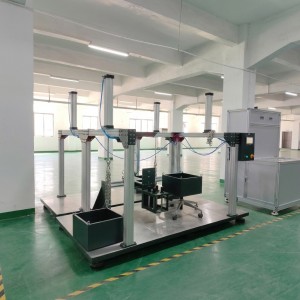
The practical advantage of a purpose-built caster durability testing machine is that it runs both passes on the same platform: a flat test surface for the no-obstacle pass, and an obstacle strip that can be added for the impact pass, all under the same settable load and stroke. That keeps the two results comparable — the same chair, the same load, the same mechanism — so a failure can be attributed to the obstacle rather than to a change in setup.
What the Test Does Not Tell You
A caster that passes both passes is not guaranteed for every surface. The test uses a defined floor condition; a caster that survives the standard obstacle may still struggle on deep-pile carpet, on uneven tiles, or under a user far above the rated mass. The test proves durability under defined, reproducible conditions — it does not replace field trials on the actual flooring the product will encounter. Knowing that boundary is what separates a defensible test report from an over-claim.
What is the difference between the obstacle and no-obstacle caster tests?
The no-obstacle test measures gradual wheel wear on a flat surface; the obstacle test measures sudden failure (wheel loss, axle loosening, base cracking) when a loaded chair is driven over a raised strip.
Why does the obstacle test use far fewer cycles?
An impact is an accelerated failure. One wheel striking an obstacle under load delivers a force spike worth many ordinary revolutions, so a few thousand controlled impacts expose weaknesses a flat-floor test would never reach.
Can a caster pass the no-obstacle test and still fail the obstacle test?
Yes. The wheel itself may be fine, but the joints — wheel stem, axle, and base arms — are only exercised by impacts, so a caster with a weak joint mechanism can pass flat-floor wear and then shed a wheel over an obstacle.
Post time: Nov-17-2026


