


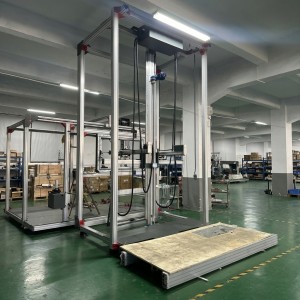
A window that opens and closes once feels fine. The question a durability test answers is what happens at cycle ten thousand, when the hinge has worn, the friction stay has lost its grip, and the lock point no longer lines up. A door and window repeated open-close durability tester is not really measuring “how many times it opens” — it is measuring which fitting fails first.
A window is a system, not a part
Every opening window is a coordinated system of components, each with its own cycle rating. The hinge carries the weight, the friction stay holds the sash at the right angle, the lock points and handle secure it closed. They wear at different rates, and the window is only as durable as the one that degrades fastest.
This is why a single “number of cycles” is misleading. A bench that simply counts open-and-close motions has told you how long the machine ran; a proper durability test tells you which component ended the run and why.
Different fittings, different ratings
The standards assign different cycle requirements to each part because each fails differently:
| Component | What the cycling exposes |
|---|---|
| Hinge | Wear at the pivot — the sash sags and the free edge drops |
| Friction stay | Loss of holding force — the sash will no longer hold its open position |
| Lock point / multi-point lock | Misalignment — the shootbolts no longer engage cleanly |
| Handle / drive gear | Backlash and rising operating force as the mechanism wears |
The hinge may be rated for tens of thousands of cycles while the handle mechanism is rated for far fewer. A complete window test must run until the weakest rated component reaches its limit — and then record what changed.
Why the machine matters more than the count
The value of a dedicated bench is not a fast motor; it is the quality of the loading. A window must be cycled through its real travel, with the handle operated and the sash driven at a realistic force, not merely flapped back and forth. Three features decide whether the test is credible:
- A high-quality custom electric cylinder drives the sash smoothly and repeatably, so every cycle is the same motion — the foundation of any fatigue claim.
- A high-precision sensing system records the operating force cycle by cycle, which is how you spot the slow rise in effort that signals an approaching failure before it happens.
- A rigid, vibration-damped aluminium frame with large anti-vibration feet keeps the fixture stable across tens of thousands of cycles, so drift in the machine is not mistaken for drift in the window.
The frame itself is a signal of intent. A detachable, high-strength aluminium structure is built for long service and easy maintenance — because a bench that flexes or shakes during a 100,000-cycle run quietly contaminates its own results.
Where the standards draw the line
Building hardware cycling is framed by GB/T 32223 for general requirements and EN 13126 for the European series, with the hinge, friction stay and lock clauses setting their own cycle and acceptance limits. For export work, the practical question is whether the bench can be reconfigured to drive doors and windows of different weights and travel, so one platform covers the catalogue.
For a Lituo machine aimed at hardware and window manufacturers, the decisive capability is that it records which fitting fails and when, rather than only reporting a pass or fail at the end. That diagnostic information is what turns a durability run into an engineering result.
Is a “cycle count” the same as a durability test?
No. A count says how long the machine ran. A durability test says which component failed and why, so the manufacturer can fix the right part.
Do all fittings have the same cycle rating?
No. Hinges, friction stays, locks and handles are each rated separately. The window is only as durable as its weakest-rated component.
Why does the drive and sensing system matter more than speed?
Because realistic travel, repeatable force and cycle-by-cycle measurement are what turn a motion into a defensible fatigue result.
Which standards should I reference?
GB/T 32223 for general hardware requirements and EN 13126 for the European series, with each component’s own clause. Confirm the current edition before specifying limits.
Post time: Nov-12-2026


