


Five tests — ring crush, edge crush, flat crush, ply adhesion and corrugated-medium crush — all end in the word “compression,” and all of them appear in a corrugated box maker’s QC file. They do not measure the same thing. In fact, they measure five different parts of the same board, and confusing them is the most quietly damaging error a packaging lab can make.
The Five Tests, in One Table
| Test | What it loads | What it proves |
|---|---|---|
| Ring crush (RCT) | A strip of paper rolled into a ring, pressed on edge | The raw paper’s resistance to edge compression |
| Edge crush (ECT) | A board standing on its edge, flute vertical | The finished board’s ability to carry stacking load |
| Flat crush (FCT) | The board pressed flat onto the flute | The flute structure’s resistance to being crushed flat |
| Ply adhesion (PAT) | The bond between liner and flute, pulled apart | Whether the layers are glued firmly enough |
| Corrugated-medium crush (CMT) | The corrugated medium alone, pressed flat | The medium’s forming and crush performance |
Ring Crush: The Paper Itself
Ring crush tests the raw material before it becomes a box. A narrow strip of paper is rolled into a ring and pressed on its edge until it buckles. The result, in kilonewtons per metre, is the liner and medium paper’s basic resistance to edge compression — the foundation every later strength is built on. It is how a paper mill and a box plant grade incoming stock, and it is why a change in ring crush shows up in the finished box long before the box itself is tested.
Edge Crush: The Board’s Real Job
Edge crush is the test that predicts whether a stack of boxes will survive. A strip of corrugated board stands on its edge with the flute vertical and is pressed until the board folds. Because a stacked box carries its load through its vertical walls — exactly the direction edge crush loads — this is the single most important number for a box that will be stacked in a warehouse or a container. It is the number behind the ECT-32 / ECT-44 style grades seen in corrugated specifications.
Flat Crush: The Flute Itself
Flat crush turns the board sideways and presses it flat, crushing the flute from the top. This measures a different thing: the flute structure’s ability to resist being flattened, which affects cushioning, board thickness stability and how the board behaves when it is converted. A board can have excellent edge crush and poor flat crush, because the two load the fibre in different directions.
Ply Adhesion: Not Compression at All
Ply adhesion is the odd one out — it is technically a peel test hiding inside a compression machine. A needle is driven between the liner and the flute tip, and the force needed to separate them is recorded. It answers whether the glue, the board moisture and the forming process produced a bond strong enough to hold the layers together under load. Delamination is a catastrophic box failure, and it is caught here, not by any crush test.
Corrugated-Medium Crush: The Medium in Isolation
The corrugated medium — the fluted inner paper — is tested on its own by forming it into a flute and pressing it flat. This isolates the medium’s contribution, so a plant can tell whether a weak board comes from poor medium or from poor combining. It is the diagnostic step that separates a raw-material problem from a manufacturing problem.
Why One Machine, Five Attachments
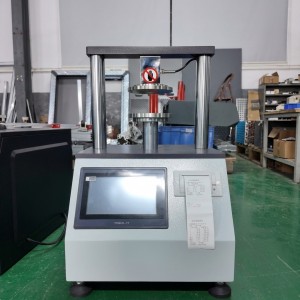
All five tests share the same fundamental action: two parallel plates move together at a controlled speed, and a load cell records the peak force before the sample collapses. What changes is the attachment — a ring holder for RCT, edge guides for ECT, a flat platen for FCT, a peel needle for PAT, and a flute former for CMT. An edge crush test machine earns its name by doing the shared part once, accurately, and letting the operator switch the part that changes. That is both the convenience and the caution: the number on the screen is only as meaningful as the attachment that produced it.
How the Standards Line Up
Each test has its own standard, and they do not substitute for one another: GB/T 6546 and ISO 3037 for edge crush, GB/T 2679.8 for ring crush, ISO 3035 and GB/T 2679.6 for flat crush, GB/T 6548 for ply adhesion, and ISO 7263 for corrugated-medium crush. A report that says “compressive strength” without naming which test it ran is not complete. As always, exact specimen sizes and conditions should be confirmed against the current edition before signing.
The Boundary: What These Tests Do Not Predict
These five tests measure the board, not the box. The full carton’s top-to-bottom compression strength depends on more than edge crush — box geometry, joint strength, print score lines and storage humidity all act on it. The board-level tests tell you the material is sound; the box-level test tells you the finished product will hold a stack. A strong board is necessary but not sufficient, and a QC programme needs both levels.
What is the difference between ring crush and edge crush?
Ring crush tests the raw paper (rolled into a ring), while edge crush tests the finished corrugated board standing on its edge. Ring crush grades incoming stock; edge crush predicts the board’s stacking strength.
Is ply adhesion a compression test?
Not really. It uses a needle to peel the liner from the flute tip and records the separation force, so it is a bond test that runs on the same compression platform as the crush tests.
Can a board have good edge crush but poor flat crush?
Yes. Edge crush loads the fibre along the flute direction, while flat crush loads it across the flute. They measure different properties and do not move together.
Post time: Nov-27-2026


