


Two quotations for a tensile testing machine can look almost identical — same capacity, same speed range, same software — and still differ by a factor of three in what they can actually measure. The gap is almost never in the headline number.
This article sets out the five parameters that decide whether a machine fits your material portfolio, in the order they affect the test result. It is written for buyers comparing offers, and for engineers who have to defend the purchase internally.
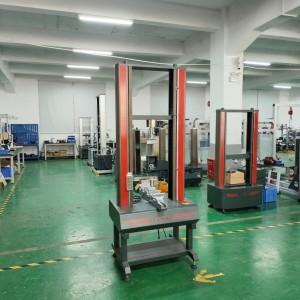
Key takeaways
- Capacity tells you the ceiling; the usable range tells you the floor. Most measurement error comes from testing far below full capacity.
- Servo control is not a luxury feature — it is what makes constant strain rate, creep and relaxation testing possible at all.
- Grips set the boundary of your material portfolio more than the frame does.
- Ask for the calibration certificate and the standards it was verified against, not the claimed accuracy figure.
Start from the report you need to issue
Machine specifications are written to be compared; test reports are written to be accepted. The useful starting point is therefore the last page of your future report — which standard, which value, which tolerance.
A lab testing elongation at break on plastic film to ASTM D882, peel adhesion on tape to ASTM D3330, and strip tensile on woven fabric to EN ISO 13934-1 needs three quite different machines in practice, even though all three are “tensile tests”. Buying one tensile testing machine to cover all three is possible — but only if the five parameters below are specified together.
1. Capacity is a range, not a number
A 5 kN machine is not accurate to 5 kN. Accuracy is verified over a defined fraction of capacity, so a load cell sized for peak load becomes progressively less reliable at the forces where films and tapes are actually tested.
Peak force and working force are rarely the same order of magnitude. A soft packaging film may break at 30 N; the same laboratory’s woven bag may need 2 kN. If one sensor covers both, the low-force test sits near the bottom of its range, where resolution is worst and the noise floor is visible in the curve.
The practical rule in most laboratories is to keep routine tests within roughly the upper half of the sensor’s range, and to hold a second, lower-capacity sensor for thin materials. When comparing offers, ask what the usable range is — not what the maximum is.
2. Speed control decides whether your data is comparable
Polymers, films and adhesives are viscoelastic: their measured strength depends on how fast you pull. Change the crosshead speed and peel strength, elongation and modulus all move, without anything about the material changing.
This is why standards specify a constant strain rate rather than an average speed, and why a computerized servo tensile testing machine is the baseline for any laboratory issuing comparable data. A fixed-speed or single-speed drive can produce a number; it cannot produce a defensible one.
Servo control also unlocks the multi-loop modes — constant stress, constant strain, creep and relaxation — which are impossible on a machine that only knows how to travel at one speed. If your product range includes gaskets, seals or geotextiles, this is a requirement rather than an option.
3. Grips decide what you can test
The frame is generic; the fixtures and grips are what make a machine suitable for cloth, film, tape, rubber or paper. Two laboratories with identical machines and different grip sets will report different results on the same material.
The common failure is at the jaw, not in the specimen. Wedge grips concentrate stress and cause premature rupture near the jaw on thin film; pneumatic grips with controlled pressure distribute it more evenly; foam or elastomer needs a grip that does not cut. Textile strip tests need jaws wide enough to hold the full specimen width without slippage.
For peel testing, the geometry matters as much as the force: 90° and 180° peel are different tests, and the fixture — not the machine — sets the angle. A quotation that lists a machine without listing the grip set is a quotation for half a system.
4. Sampling rate and what the software can export
Peak force is a single point. Modulus, yield behaviour and the shape of the failure curve all depend on how densely the data was sampled, and on whether the software can compute the derived values the standard asks for.
Two practical checks. First, whether the software calculates the derived results natively — elongation at a specified stress, secant modulus, energy to break — or whether an operator is expected to post-process in a spreadsheet, which is where traceability quietly disappears. Second, whether raw data can be exported with the curve intact, because a report showing only a verdict is difficult to defend when a customer disputes a batch.
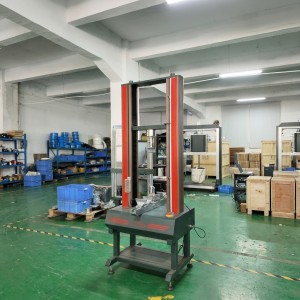
5. Frame stiffness and alignment
A universal testing machine frame that deflects under load is measuring itself as well as the specimen. On rigid samples the error is small; on high-elongation film and fine fibres, crosshead compliance and poor column alignment can shift results by more than the differences you are trying to detect between batches.
Alignment is invisible in a specification sheet, which is why it is worth asking for the verification report rather than the frame drawing. For routine quality control the requirement is modest; for a laboratory issuing accredited data, ISO 7500-1 class verification of force indication, together with a flatness and alignment check, is the evidence a third party will actually look at.
Three things missing from most quotations
- The calibration certificate and its reference standard. ”Accuracy ±0.5%” means little without knowing what it was verified against and over what range.
- The full grip inventory. A price that excludes the fixtures you need is not a lower price.
- Software licensing and upgrade terms. A second workstation licence is often the difference between one operator and a functioning quality system.
A short buying checklist
- List every standard your laboratory must report against, then map each to a force range, a speed and a grip type.
- Specify two sensors if your materials span more than about one order of magnitude in breaking force.
- Require servo control and confirm the multi-loop modes are included, not optional.
- Ask for a demonstration on your own material, not on a standard steel specimen.
- Confirm the report template matches the format your customers or accreditation body expects.
Lituo has manufactured material and mechanical testing instruments since 2008. The computerized servo tensile testing machine series covers tensile, compression, bending, shear, tear and peel testing, with constant-stress, constant-strain, creep and relaxation modes, and is supplied with a configurable fixtures and grips set for textile, film, tape, rubber and paper. View the tensile testing range →
Frequently asked questions
What capacity do I need for plastic film?
Usually far less than for packaging or textiles. Measure the breaking force of your thinnest and thickest products first, then size the sensor so the thin products are not tested at the very bottom of the range.
Can one machine test both film and woven bags?
Mechanically yes, over a wide capacity range. In practice the force levels differ by two orders of magnitude, so accuracy on the film suffers unless a second, lower-capacity load cell is fitted.
Is a servo drive necessary for simple tensile tests?
For routine pass/fail it is convenient. For any test where the standard specifies a rate of strain, or where creep and relaxation must be measured, it is required — a fixed-speed drive cannot maintain a controlled rate under changing load.
How often should the machine be verified?
Force indication is normally verified annually against traceable standards, with an interim check after any overload event, sensor replacement or relocation of the frame.
Post time: Oct-23-2026


