


A sofa is judged by comfort on day one, but by structure on day one thousand. A sofa durability tester exists to compress those thousand days — and the decades behind them — into a few reproducible hours of loading, so that a manufacturer can measure, before shipping, how long the seat and backrest will actually hold up.
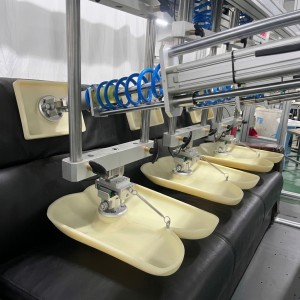
What a Sofa Durability Tester Actually Measures
A sofa durability tester applies repeated, controlled load to the seat and backrest to quantify structural fatigue.
- Seat fatigue:measures how the seat frame, springs, and cushion resist repeated downward loading.
- Backrest fatigue:measures how the backrest frame and its attachment hold up under repeated backward loading.
- Combined seat-and-backrest loading:simulates a person sitting and leaning at the same time, the load case that causes most real-world failures.
- Cycle counting:tracks the exact number of load cycles a component survives before visible deformation or breakage.
The output is a measured cycle count and a pass/fail judgement, not a subjective opinion.
Why “Feels Sturdy” Is Not a Test
Manual inspection cannot predict long-term sofa failure. Fatigue failures are invisible until they are measurable.
- A sofa can look and feel solid while its joints slowly loosen under repeated load.
- Seat springs lose tension gradually, not suddenly; only controlled cycling reveals the trend.
- Backrest attachment points are a common hidden failure zone that visual checks miss.
- Reproducible loading gives a cycle count that can be compared across designs, materials, and suppliers.
A sofa durability tester turns “it feels sturdy” into “it survived 20,000 cycles at a defined load.”
Standards That Define Sofa Durability Testing
Sofa durability is judged against published standards that specify the load, the number of cycles, and the pass criteria.
- GB/T 10357.3:a Chinese national standard covering strength and durability tests for upholstered seating.
- EN 1728:a European standard for the durability of domestic seating furniture.
- BIFMA X5.4:a North American standard covering lounge and public-area seating durability.
- QB/T 1952.1:a Chinese industry standard for upholstered furniture quality.
Testing to a named standard makes results comparable and export-acceptable, rather than proprietary.
Key Parameters That Determine Test Quality
Not every sofa durability tester delivers the same measurement. The decisive specifications are below.
| Parameter | LT-JJ26 Value | Why It Matters |
| Test stations | 3 | Seat and backrest tested separately or jointly, per station |
| Force sensor | 500 kg (seat + backrest) | Covers the load range of domestic and contract seating |
| Display accuracy | 0.1 kg | Fine resolution for small load steps |
| Display precision | ±1% of reading | Traceable, repeatable force measurement |
| Cycle counter | 0–999,999 per station | Independent counting for each position |
| Position adjustment | seat L-R; backrest L-R & up-down | Fits single, double, and three-seat sofas |
| Control | PLC + touchscreen | Automated, programmable loading sequences |
| Air source | 6 kgf/cm² or above | Pneumatic actuation for consistent loading |
These specifications define whether a test can be reproduced in a different laboratory on a different day.
How a Sofa Durability Test Runs in Practice
A typical durability sequence follows a repeatable, standards-based workflow.
- Mount and adjust:the sofa is positioned, and the seat and backrest loading points are aligned to the product’s geometry.
- Set the load:the target force for seat and backrest is entered on the touchscreen.
- Set the cycle count:the required number of load cycles is programmed per station.
- Run the cycle:pneumatic actuators apply the load repeatedly at the set frequency.
- Record the outcome:the cycle counter logs performance, and the sofa is inspected for deformation or breakage.
The result is a logged, comparable durability record rather than an anecdote.
Why Sofa Manufacturers Test Before They Ship
Durability testing is an engineering and commercial decision, not a formality.
- Reduce returns:sofas that survive measured fatigue cycles fail less often in customers’ homes.
- Qualify suppliers:frame, spring, and cushion suppliers can be compared against a common pass line.
- Support export certification:standards-based results are accepted by overseas buyers and test bodies.
- Shorten design cycles:a failed prototype is caught in hours, not after months in the field.
A sofa durability tester pays for itself the first time it prevents a batch of chairs from failing in the market.
FAQ
Q: How many sit-down cycles should a good sofa survive?
A: A domestic sofa is commonly tested to thousands of load cycles (for example, 20,000 or more depending on the standard and product grade). The exact requirement comes from the applicable standard — GB/T 10357.3 or EN 1728 — and the intended use.
Q: Can one sofa durability tester handle different sofa sizes?
A: Yes. A sofa durability tester with adjustable seat (left-right) and backrest (left-right and up-down) positions, like the LT-JJ26, can accommodate single, double, and three-seat sofas without changing frames.
Q: What is the difference between seat and backrest durability testing?
A: Seat testing measures resistance to downward loading on the sitting surface, while backrest testing measures resistance to backward loading on the back support. A combined mode applies both at once, reproducing the most demanding real-world load case.
Post time: Nov-25-2026


