


The office chair base is one of the most important structural components of an office chair. It supports the user’s weight, transfers loads to the casters, and must withstand repeated loading during everyday use.
A chair base may look simple, but defects such as cracking, deformation, insufficient strength, poor connections, or material failure can affect both product durability and user safety. For manufacturers, establishing an effective quality control process is therefore essential.
1. Select Appropriate Materials and Components
The first step in preventing office chair base problems is controlling the quality of raw materials and components.
Depending on the product design, manufacturers should pay attention to:
- Material strength and consistency
- Casting or molding quality
- Wall thickness and structural design
- Surface defects
- Connection and mounting areas
- Dimensional accuracy
Material quality problems may not always be visible during routine visual inspection. A component that appears acceptable can still fail when subjected to high or repeated loads.
Therefore, material inspection should be combined with mechanical performance testing.
2. Pay Attention to the Five-Star Base Structure
The five-star base is commonly used in office chairs because its multi-arm structure provides stable support.
However, stress is not necessarily distributed evenly throughout the base. The central connection, arms, caster mounting points, and other load-bearing areas may experience significant stress during use.
Manufacturers should therefore evaluate the complete base structure rather than checking only individual components.
Design verification should consider:
- Maximum expected user load
- Load distribution
- Base geometry
- Connection strength
- Potential deformation
- Long-term fatigue conditions
Testing during the product development stage can help identify weak structural areas before mass production.
3. Perform Static Compression Testing
One of the most effective ways to identify structural weaknesses is to perform a controlled static load test.
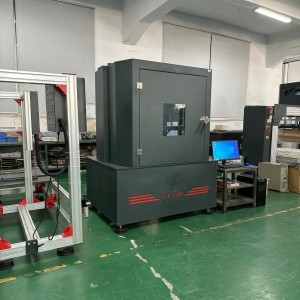
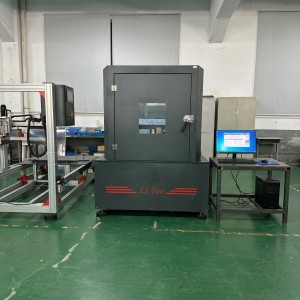
The Computer-Controlled Office Chair Five-Star Base Static Compression Testing Machine is designed specifically for evaluating the static load-bearing strength of office chair bases.
The machine can provide a maximum load of 2000 kg or 5000 kg, allowing manufacturers to apply controlled compression loads to the chair base and evaluate its structural performance.
During testing, manufacturers can monitor force and displacement while observing whether the base develops:
- Permanent deformation
- Cracks
- Structural instability
- Connection failure
- Excessive displacement
- Other abnormal deformation
This makes the Office Chair Five-Star Base Static Compression Testing Machine useful not only for final quality inspection but also for product development and design verification.
4. Use Accurate and Repeatable Test Conditions
Testing results are only useful when test conditions are stable and repeatable.
Manual testing can introduce differences in loading speed, force, and test duration. Computer-controlled equipment can reduce these variations and provide more consistent testing conditions.
The testing machine provides a testing speed range of:
0.001–500 mm/min
It also features:
- Load resolution: 1/100,000
- Displacement resolution: 0.001 mm
- Panasonic servo motor
- Computer-controlled speed and displacement
- Programmable maximum load
- Programmable maximum extension
- Automatic stop function
These functions allow manufacturers to establish standardized testing procedures for different chair models.
5. Monitor Force and Displacement Curves
A simple pass/fail result may not provide enough information for product improvement.
Force-displacement data can help engineers understand how the chair base behaves under increasing load.
For example, an abnormal change in the curve may indicate:
- Structural deformation
- Local yielding
- Insufficient material strength
- Weak connection points
- Unexpected mechanical behavior
By comparing test curves from different product designs or production batches, manufacturers can identify trends and improve the structure before problems become widespread.
6. Strength Testing Should Be Part of Quality Control
Static compression testing should not be treated as an isolated laboratory activity.
For mass production, manufacturers can incorporate testing into their broader quality management process.
A practical quality control workflow may include:
Raw Material Inspection → Component Inspection → Assembly Inspection → Static Compression Testing → Data Analysis → Batch Quality Evaluation
When abnormal test results occur, manufacturers can investigate the relevant production batch and determine whether the problem is related to materials, molding, casting, assembly, or structural design.
This approach is more effective than relying solely on visual inspection.
7. Follow Appropriate Testing Standards
Different markets may have different requirements for office chair performance.
The Computer-Controlled Office Chair Five-Star Base Static Compression Testing Machine can be used in testing programs associated with standards such as:
- QB/T 2280-2016
- BIFMA X5.1-2017
- EN 1335:2000
Manufacturers should always confirm the latest applicable edition and the specific test requirements for their target market before establishing a compliance testing program.
8. Combine Design Improvement with Testing Data
When a chair base fails a test, simply replacing the component may not solve the underlying problem.
Engineers should analyze the failure location and determine why the failure occurred.
For example:
Crack at the arm → Check material and structural thickness
Deformation at the center → Review load distribution and central connection
Caster mounting failure → Check local reinforcement and connection design
Excessive overall deformation → Review material selection and base geometry
Testing data can therefore provide direct feedback for product development.
Conclusion
Preventing office chair base quality problems requires more than visual inspection. Manufacturers need to control materials, optimize structural design, establish repeatable testing procedures, and continuously analyze test data.
In particular, static compression testing can provide valuable information about the load-bearing capability and structural reliability of a five-star chair base.
Using the Computer-Controlled Office Chair Five-Star Base Static Compression Testing Machine, manufacturers can conduct controlled load testing, monitor force and displacement, identify potential structural weaknesses, and obtain reliable data for product improvement.
A well-designed testing process can help manufacturers improve office chair base quality, reduce failure risks, and build more reliable products for demanding international markets.
Post time: Oct-10-2026


