



Where Raw Power Meets Digital Precision: The Hydraulic Computerized Universal Testing Machine
Testing the backbone of modern industry—structural steel, bridge cables, aircraft components, or concrete pillars—demands more than a standard bench-top tester. It requires immense force, measured in hundreds of kilonewtons or even meganewtons. This is the domain of the Hydraulic Computerized Universal Material Tensile Testing Machine. This formidable instrument marries the raw, high-force capability of hydraulic systems with the pinpoint accuracy and intelligent control of advanced computer software. It is the definitive solution for determining yield strength, tensile strength, and elongation of materials under extreme loads, serving as the gold standard for research, quality certification, and failure analysis where there is zero margin for error.
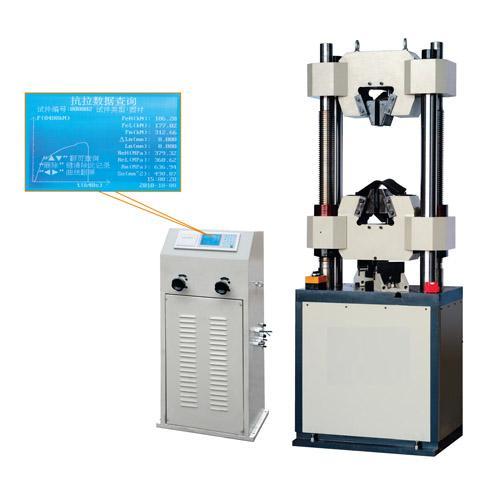
What is a Hydraulic Computerized Universal Testing Machine?
A Hydraulic Computerized Universal Material Tensile Testing Machine is a high-capacity testing system that uses a servo-controlled hydraulic power unit to generate force for tension, compression, bending, and shear tests. The “Hydraulic” component refers to the use of a hydraulic cylinder and pump to produce the massive force required. The “Computerized” aspect is critical: it involves a closed-loop digital controller and software that precisely regulate oil flow and pressure, enabling accurate control over force, displacement, and strain rates. This synergy creates a servo-hydraulic universal testing machine capable of delivering both ultra-high static forces and dynamic, cyclic loading for advanced material mechanical properties analysis.
Core System Architecture: Synergy of Power and Control
The machine’s capability stems from its integrated subsystems:
- Servo-Hydraulic Power Pack: The heart of the system, featuring a high-pressure pump, accumulator, and a responsive servo-valve that translates digital commands into precise hydraulic motion.
- High-Stiffness Load Frame: A massively rigid structure (often dual or four-column) designed to withstand extreme forces without deformation, ensuring test accuracy.
- Precision Hydraulic Actuator: The cylinder that converts hydraulic pressure into linear force. Its design is key for smooth operation and dynamic testing capabilities.
- Digital Controller & Advanced Software: The brain. It allows programming of complex test profiles (static, cyclic, ramp), real-time data acquisition, and sophisticated analysis compliant with standards like ASTM E8 for metals or concrete compression test standards.
Key Testing Capabilities: From Static Crush to Dynamic Fatigue
This machine’s versatility extends far beyond simple tensile pulls:
- High-Force Tensile & Compression Tests: Measures yield point, ultimate tensile strength, and elastic modulus for high-strength metals, composites, and construction materials.
- Low-Cycle Fatigue & Fracture Mechanics: Its ability to apply programmed, cyclic loads makes it ideal for studying crack propagation and material durability under repeated stress.
- Bend, Shear, and Bearing Tests: With appropriate fixtures, it evaluates material performance under complex, real-world stress states.
- Component and Structural Testing: Large test space and high force allow for testing full-scale components like rebar, bolts, joints, or concrete beams, not just small coupons.
The Precision Testing Workflow: Commanding Immense Force with Finesse
Operating this powerhouse is a controlled, technology-driven process:
- Fixture & Sample Installation: Massive hydraulic or mechanical grips secure high-strength samples. Extensometers are attached for precise strain measurement.
- Test Profile Programming: Engineers define the test type (load control, displacement control, strain control), speed, and any complex multi-stage profile in the software.
- Servo-Controlled Execution: The servo-valve meticulously regulates oil flow to the actuator, applying force with exceptional smoothness and control, even during a high capacity tensile test at maximum load.
- High-Fidelity Data Acquisition: The system samples force, displacement, and strain data at high rates, capturing the complete material behavior curve up to fracture.
- Comprehensive Analysis & Reporting: Software automatically calculates all key parameters and generates detailed, certifiable reports essential for research and compliance.
The Strategic Advantage: Why Choose Hydraulic Computerized Precision?
Opting for this system is a strategic decision for organizations working at the forefront of technology:
- Access to Extreme Force Ranges: Unlocks testing capabilities (from 300kN to 10,000kN+) unattainable with electromechanical machines, enabling R&D on next-generation materials.
- Superior Dynamic Performance: Essential for fatigue, fracture, and simulation testing where load must be varied rapidly and accurately according to a complex waveform.
- Uncompromising Data Authority: Provides the gold-standard data required for critical certifications in aerospace, civil engineering, energy, and defense—sectors where data integrity is paramount.
- Future-Proof Versatility: A single high-capacity frame can be adapted for a vast range of tests with different fixtures, offering long-term value as testing needs evolve.
Key Selection Criteria for Your High-Force Testing Lab
Selecting the right Hydraulic Computerized Universal Material Tensile Testing Machine requires careful consideration:
- Force Capacity & Frame Type: Choose a capacity with headroom above your current needs. Decide between dual-column (accessibility) and four-column (maximum rigidity) frames.
- Servo-Hydraulic System Quality: Evaluate the responsiveness and reliability of the servo-valve and power pack. System stability directly impacts test accuracy.
- Controller & Software Sophistication: The software must support both standard static tests and advanced programming for dynamic and multi-axial protocols.
- Space, Foundation & Utilities: These are large systems requiring substantial lab space, a solid foundation, and adequate electrical power and cooling.
Conclusion: The Foundational Tool for Advanced Material Science
The Hydraulic Computerized Universal Material Tensile Testing Machine is more than a heavy-duty tester; it is a foundational tool for expanding the boundaries of material science and engineering. It provides the definitive answer when the question is, “How strong is it—really?” By marrying immense force with digital precision and intelligent control, it delivers trustworthy data that validates theoretical models, certifies safety-critical components, and drives innovation in the world’s most demanding industries. Investing in this capability is an investment in the authority of your research and the reliability of the structures that shape our modern world.
Post time: Dec-18-2025


