



Lead Core Wear Testing Machine: The Complete Guide to Pencil Abrasion Resistance Testing
Introduction: The Science of Measuring Pencil Performance
For centuries, the “feel” of a pencil remained a subjective experience. An artist might prefer one brand’s 2B for its smoothness, while an engineer demands another’s H grade for its fine, resistant line. This subjectivity ends in the modern quality control laboratory. The Lead Core Wear Testing Machine (also known as a pencil abrasion tester or lead core abrasion tester) transforms the abstract concept of abrasion resistance into reliable, quantitative data. This specialized instrument validates batch consistency, ensures compliance with industry standards like QB/T 2774-2006 clause 5.3, and builds brand trust by guaranteeing that every pencil in a given grade performs identically.
What is a Lead Core Wear Testing Machine?
A lead core wear testing machine is a specialized laboratory instrument designed to objectively measure the wear resistance of pencil leads under standardized, controlled conditions. Its primary function is to quantify the amount of lead material worn away after a fixed number of rotations against a specific type of paper or abrasive surface. This measured “abrasion value” is directly correlated to the pencil’s hardness grade on the ‘H’ or ‘B’ scale. By eliminating human variables—such as inconsistent writing pressure, speed, and angle—this tester provides manufacturers with a definitive metric to ensure that a 2B pencil from one batch has the same softness and durability as a 2B from the next. It is the cornerstone of objective writing instrument quality control.
Core Testing Principles: Simulating the Act of Writing
The fundamental principle of this machine is to simulate the friction between a pencil lead and paper during writing or drawing. The pencil lead undergoes repeated writing or drawing cycles to replicate real-world abrasion conditions. Through precise, controlled loading and motion, the tester compresses years of typical use into a short, standardized laboratory procedure.
Key Testing Methods
- Reciprocating Abrasion Method: The pencil lead is pressed against a standardized abrasive paper or surface and moved back and forth repeatedly over a fixed distance, simulating the back-and-forth motion of handwriting.
- Rotating Drum Method: The lead is applied to a rotating drum covered in abrasive material, simulating a continuous drawing or writing motion. This method is commonly used in machines compliant with QB/T 2774-2006 and GB/T 26704-2011.
- Point Wear Method: Measures the resistance of a sharpened pencil point to blunting under controlled conditions, directly related to its overall abrasion resistance.
The Science Behind Standardization: Critical Test Parameters
The accuracy and repeatability of the lead wear test depend on several tightly controlled variables. The QB/T 2774-2006 standard and similar international protocols specify these parameters in detail.
Paper Conditioning (Baking at 303°C)
This critical step removes residual moisture from the writing paper. Moisture can act as a lubricant on paper fibers, drastically reducing measured abrasion and leading to falsely low wear values. Baking the paper at 303°C for 2 hours, followed by cooling in a desiccator for 2 hours and storage in a sealed bag for use within one week, ensures a consistent, dry abrasive surface for every test.
Precise Lead Sharpening and Preparation
Using a specified sharpener and then sanding the lead to an exact diameter is fundamental. The standard specifies that leads for harder grades (HB to 10H) are sanded to 0.7mm, while softer and colored leads (B to 6B) are sanded to 0.8mm using W14 metallographic sandpaper. This ensures the initial contact point and surface area are identical for all samples, which is essential for a repeatable test.
Controlled Applied Force
A calibrated weight, typically 300 grams, is applied to the pencil to simulate consistent writing pressure. This eliminates the variable of hand pressure, ensuring that measured wear is due to the lead’s intrinsic properties, not the execution of the test. The machine’s load system allows for consistent force application throughout the entire test cycle.
Controlled Rotation Speed and Cycles
The machine operates at a specified speed, commonly 40 cycles per minute (40 cpm). The total number of cycles is predetermined based on the standard being followed, ensuring that all samples undergo the same degree of abrasion.
Technical Specifications of Standard Testing Equipment
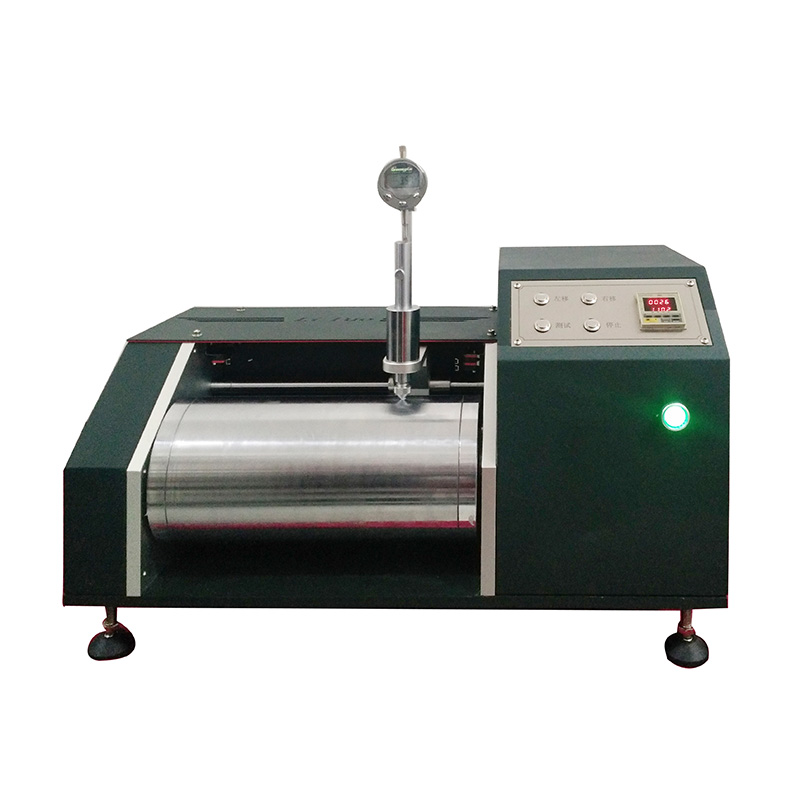
A professional lead core wear testing machine typically includes the following specifications, as seen in models like the HY-317 and LT-WJB08:
- Weights: Interchangeable loads, commonly including 150g, 200g, and 300g to accommodate different test standards and lead grades.
- Roller Speed: Standardized at 40 cycles per minute (cpm).
- Measurement System: High-precision digital indicator (often from brands like Mitutoyo) to measure lead length loss after testing.
- Abrasive Medium: W14 metallographic sandpaper and 80g/m² writing paper as specified by the standard.
- Core Tip Gauge Plate: Precision apertures of 0.7mm and 0.8mm for accurate lead tip preparation.
- Dimensions and Weight: Approximately 760 × 335 × 437 mm (W × D × H) and 50 kg.
- Power Supply: AC220V 50Hz.
Step-by-Step Testing Protocol
Following a standardized method is paramount for obtaining reliable, comparable results. Here is a clear step-by-step breakdown of the typical pencil lead wear test process:
- Paper Preparation: Condition the writing paper by baking it at 303°C for 2 hours. Cool it in a desiccator for 2 hours, and store it in a sealed plastic bag for use within one week.
- Sample Selection and Sharpening: Select the pencil sample. Sharpen it using a standardized sharpener. Insert the lead into the appropriate gauge (0.7mm for HB-10H, 0.8mm for B-6B/colored) and sand the excess lead flush with the gauge using W14 metallographic sandpaper.
- Machine Setup: Attach the conditioned paper to the rotating drum. Mount the pencil in the holder, balance the lever mechanism, and apply the calibrated weight (e.g., 300g).
- Zeroing and Pre-Test Measurement: Reset the revolution counter and zero the dial indicator (micrometer) that measures lead length.
- Test Execution: Activate the machine. The drum rotates at the specified speed (typically 40 cpm), and the lead is abraded against the paper for the predetermined number of cycles.
- Post-Test Measurement: After the machine stops, the lead length is measured again using the digital indicator. The difference represents the wear loss.
- Data Analysis: The wear value is recorded and compared against internal specifications or regulatory requirements to determine if the pencil meets the required hardness and durability grade.
Applications in Manufacturing and Quality Control
The lead core wear testing machine is indispensable for manufacturers of writing instruments, as well as for regulatory bodies and third-party testing laboratories. Its primary applications include:
- Grade Validation: Ensuring that pencils labeled with a specific hardness grade (e.g., 2B, HB, 2H) consistently produce the expected wear performance. Softer leads (B grades) wear faster, while harder leads (H grades) are more resistant.
- Batch Consistency: Testing samples from different production batches to ensure that the lead formulation and manufacturing process remain stable and produce identical results.
- Material Development: Quantifying how changes in the graphite-to-clay ratio or the introduction of new binder materials affect the wear resistance and overall performance of the pencil lead.
- Compliance and Certification: Generating auditable test data to demonstrate compliance with national standards such as QB/T 2774-2006 (for pencils) and GB/T 26704-2011 (the national standard for pencils in China).
- Competitive Benchmarking: Comparing the wear resistance of a manufacturer’s own products against those of competitors to establish market positioning.
Compliance with International and National Standards
A professional lead core wear testing machine is designed to meet the requirements of several key standards, ensuring its results are recognized worldwide. Primary standards include:
- QB/T 2774-2006 Clause 5.3: The specific Chinese industry standard for pencils, which details the abrasion test method. This is the core compliance standard for most machines in the Chinese market.
- GB/T 26704-2011: The Chinese national standard for pencils, which supersedes some earlier regulations and includes similar abrasion testing requirements.
- QB/T 1024-2007: A related standard for markers and similar writing instruments, which may reference similar abrasion test principles.
- ISO 20318-2:2019: The international standard for black leads for mechanical pencils, which specifies classification, quality, and test methods, including wear-related performance.
Advantages of Automated Lead Wear Testing Over Manual Methods
While it is possible to manually assess pencil hardness through subjective “scratch” tests, automated lead wear testing offers several distinct advantages that make it the superior choice for professional quality assurance:
- Exceptional Repeatability and Reproducibility (R&R): The machine eliminates human variability in angle, pressure, and stroke speed, which is critical for reliable data and passing audit standards. Two different operators will get the same result on the same sample.
- Quantitative Data: Instead of a subjective pass/fail judgment or a comparative scratch, the tester provides a precise numerical value for wear loss (in millimeters or grams), enabling statistical process control (SPC) and trend analysis.
- High Efficiency: The machine can run multiple samples in sequence or, in some configurations, multiple samples simultaneously. It operates unattended, freeing up technician time and increasing laboratory throughput.
- Objective Grading: The numerical wear value can be directly correlated to the HB hardness scale, creating an objective, data-driven link between a pencil’s stated grade and its actual physical performance.
The Business Case: Why Invest in Professional Wear Testing?
For manufacturers of pencils and other writing instruments, investing in a lead core wear testing machine delivers tangible business benefits that extend far beyond simple compliance:
- Reduced Customer Complaints and Returns: By ensuring every batch meets the specified wear characteristics, manufacturers minimize the risk of customers receiving pencils that feel “scratchy,” wear down too quickly, or do not match the expected grade.
- Stronger Brand Reputation for Consistency: Artists, students, and professionals rely on their favorite pencil brands to perform identically every time they purchase a new pack. Validated consistency builds loyalty and trust.
- Improved Product Development: Quantifying the wear performance of different lead formulations allows R&D teams to rapidly iterate and optimize for the perfect balance of smoothness, darkness, and longevity.
- Regulatory Compliance and Market Access: For manufacturers exporting to regions with strict quality standards (such as China with GB/T 26704-2011 or Europe with ISO 20318-2), documented wear testing is often a prerequisite for market entry and avoiding customs holds.
- Competitive Differentiation: A manufacturer that can publish and guarantee specific, tested wear metrics for each pencil grade gains a significant marketing advantage over competitors who rely on subjective claims.
Selecting the Right Lead Core Wear Testing Machine
When choosing a lead core wear testing machine for your laboratory or quality control department, consider the following factors to ensure you select the right equipment for your needs:
- Standard Compliance: Verify that the machine is specifically designed to meet the test methods described in QB/T 2774-2006 clause 5.3 or the relevant international standards for your target market.
- Precision of Measurement: Look for a machine equipped with a high-resolution digital indicator (such as a Mitutoyo unit) capable of measuring wear loss in increments of 0.001mm or better.
- Load Versatility: Ensure the machine includes a range of calibrated weights (e.g., 150g, 200g, 300g) to accommodate testing different pencil types, from soft colored pencils to hard drafting leads.
- Build Quality and Stability: A rigid, vibration-damped frame is essential for consistent results. Machines weighing approximately 50 kg typically offer the necessary stability for precise measurements.
- Ease of Use and Data Management: Consider machines with intuitive controls, clear digital displays, and software capabilities for logging test parameters and generating reports.
Conclusion: From Subjective Feel to Objective Science
The Lead Core Wear Testing Machine epitomizes how precision engineering is applied to measure the performance of one of the world’s most ubiquitous tools—the pencil. It transforms the simple concept of “how quickly a pencil wears down” into a reliable, data-driven metric for quality assurance, material development, and compliance with global benchmarks. For manufacturers of pencils, mechanical pencil leads, and colored pencils, investing in this specialized equipment is an investment in product consistency, customer satisfaction, and a reputation for reliability. It ensures that whether for a student’s homework, an architect’s blueprint, or an artist’s sketch, the mark left behind is consistently, predictably excellent.
Post time: Apr-07-2026


