



The Intelligent Revolution in Packaging QC: How Microcomputer Control Eliminates Guesswork
For decades, determining a box’s strength was a manual affair—cranking handles, watching gauges, and hoping the operator’s timing was perfect. This introduced a hidden tax of human variability into every critical Box Compression Test (BCT) result. The Microcomputer-controlled Cardboard Compression Testing Machine ends this era. By integrating a high-precision load cell with an onboard microcomputer, it transforms packaging testing from an artisanal skill into a precise, repeatable science. This intelligent system doesn’t just measure force; it controls the entire test, captures data flawlessly, and delivers irrefutable reports, making it the new standard for labs that value data integrity over speed.
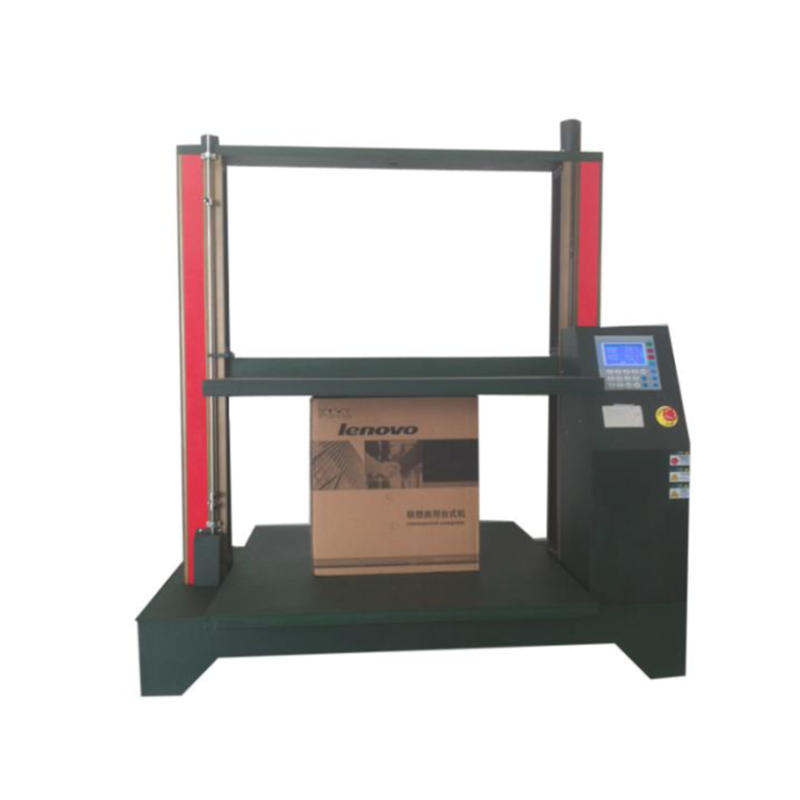
What is a Microcomputer-Controlled Cardboard Compression Tester?
A Microcomputer-controlled Cardboard Compression Testing Machine is an electromechanical testing instrument where the core functions—speed control, data acquisition, calculation, and reporting—are managed by an integrated microprocessor or embedded computer system. As highlighted in your product description, it utilizes a high-accuracy load cell as its sensing heart, which converts the physical crushing force into an electrical signal. The microcomputer then samples this signal thousands of times per second, filters noise, and calculates the peak compressive strength of containers like corrugated boxes, plastic crates, or composite materials. This closed-loop intelligence ensures that tests for BCT (Box Compression Test) and ECT (Edge Crush Test) are performed with unwavering consistency, independent of the operator.
Core Technology: The Synergy of Sensor and Silicon
The machine’s reliability stems from the perfect marriage of its two key components:
- The High-Precision Load Cell: This is the primary transducer. As the platen compresses the box, microscopic deformations within the load cell change its electrical resistance. Its quality directly defines the system’s accuracy (e.g., ±0.5% of full scale) and ability to detect true peak force without inertia-induced error.
- The Microcomputer Control System: This is the brain. It performs multiple critical tasks:
- Motion Control: Precisely drives the motor to maintain the constant test speed required by standards like ASTM D642.
- Signal Processing: Amplifies and digitizes the analog signal from the load cell with high resolution.
- Real-time Calculation: Instantly identifies and locks the maximum force (peak load) the sample withstands.
- User Interface: Provides a digital display (often LCD) for setup and real-time readouts of force and displacement.
- Data Output: Sends results to a built-in printer, internal memory, or a connected PC for further analysis.
Key Testing Capabilities Enabled by Intelligence
The intelligence of the microcomputer unlocks testing capabilities beyond simple crushing:
- Constant-Speed Compression (Standard BCT/ECT): The primary mode, perfectly adhering to international standards for determining maximum stacking strength.
- Load-Hold or Creep Testing: Can apply and maintain a specific force for a set duration to assess a box’s long-term deformation under static load, predicting warehouse stacking behavior.
- Programmable Multi-Stage Testing: Allows for complex test profiles, such as compressing to a force, holding, then continuing, useful for evaluating package performance under sequential loads.
- Automatic Peak-Value Capture & Zeroing: Eliminates the need for the operator to manually watch and record the peak value. The system automatically finds, holds, and displays it, then resets for the next test.
The Automated, Error-Proof Testing Workflow
Operating a modern computerized box compression tester is designed to be simple and foolproof:
- Power-On & Self-Check: The system initializes, often performing a quick self-diagnostic and verifying calibration status.
- (Optional) Parameter Input: For non-standard tests, speed or units (N, lbf, kgf) can be set via a keypad or menu.
- Sample Placement & Test Initiation: The box is centered on the lower platen. The operator presses a single button (e.g., “Test” or “Down”).
- Fully Automatic Execution: The machine lowers the platen at constant speed, continuously monitors force, captures the peak value, and automatically returns to the start position.
- Result Readout & Documentation: The peak compression strength is displayed prominently. With a built-in printer, pressing “Print” generates a permanent test ticket with all relevant data.
The Tangible Business Benefits of Upgrading to Computerized Control
Upgrading from manual testers delivers immediate and long-term return on investment:
- Unassailable Data Integrity: Results are objective and repeatable. This eliminates disputes with suppliers or customers over testing methodology, providing defensible data for quality agreements.
- Dramatically Reduced Operator Dependency & Error: Minimal training is required. The system removes human error in reading gauges and timing peak force capture, standardizing output across all shifts and personnel.
- Streamlined Compliance & Auditing: The automated process naturally complies with the strict procedural requirements of standards like GB/T 4857.4 or ISO 12048, making audits smoother.
- Foundation for Statistical Process Control (SPC): Consistent digital data can be easily recorded and analyzed to monitor material quality trends over time, enabling proactive process improvements.
Key Selection Criteria for Your Smart Tester
When selecting a Microcomputer-controlled Cardboard Compression Testing Machine, focus on these critical specifications:
- Control System Stability & Features: Ensure the software is intuitive and the processor is robust enough for smooth operation without lag or crashes.
- Load Cell Accuracy & Capacity: Match the force capacity (e.g., 5kN, 10kN, 20kN) to your strongest boxes. Prioritize rated accuracy (e.g., Class 0.5 or better).
- Calibration Security & Traceability: The system should support easy, traceable calibration with password-protected settings to prevent unauthorized modification.
- Data Export & Connectivity: Evaluate output needs: built-in printer, USB data export, or RS-232 connection to external software for database management.
- Compliance with Relevant Standards: Verify the machine’s design and software algorithms are validated for the specific standards you need to follow (ASTM, ISO, GB).
Conclusion: The New Baseline for Confident Packaging Validation
In today’s data-driven manufacturing environment, intelligent control is no longer a luxury—it’s the baseline for credible quality assurance. The Microcomputer-controlled Cardboard Compression Testing Machine provides more than just a number; it provides the confidence that the number is correct. By removing variability and automating precision, it empowers packaging engineers, quality managers, and production teams to make decisions based on truth, not estimation. Investing in this technology is a direct investment in reducing material waste, preventing shipping failures, and building a reputation for reliable, certifiable quality that stands up to scrutiny.
Post time: Dec-29-2025


