



The Critical Test Your Chair’s Back Never Knew It Needed: The Pull-Back Durability Machine
The office chair backrest and its tilt mechanism are engineering marvels under constant, unseen stress. Every lean back, every stretch, every shift in posture applies repetitive force to springs, synchro-tilt mechanisms, gas lifts, and structural joints. A failure here isn’t just a broken chair; it’s a potential injury and a major brand liability. How can manufacturers simulate a decade of user “lean time” in a matter of days? The Office Chair Pull Back Testing Machine (Front Push) is the engineered answer. This sophisticated, multi-function simulator applies precise, programmable forces to the chair back, rigorously validating the life of the tilt mechanism and the structural integrity of the entire back assembly. This guide reveals how it acts as your first line of defense against field failures.
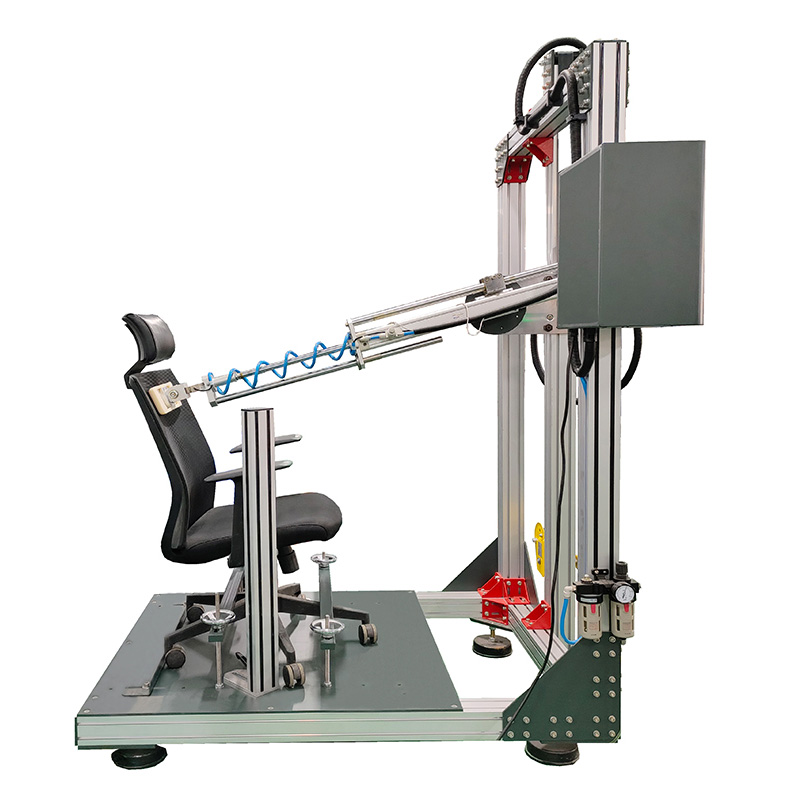
What is an Office Chair Pull Back Testing Machine?
An Office Chair Pull Back Testing Machine is a specialized, programmable robotic system designed to evaluate the long-term durability of an office chair’s backrest and its reclining (tilt) mechanism. As your description highlights, it’s a versatile multi-function device. Its core action simulates a person repeatedly leaning back in the chair by applying a controlled pushing force to the upper backrest. The system’s intelligence lies in its adjustability: the pneumatic cylinder can rotate and move along a height-adjustable beam to perfectly align with any chair model. It can deliver a specified constant force or execute repeated strokes to a set position, making it the definitive instrument for a comprehensive chair back durability test and tilt mechanism life validation.
Engineering Precision: The Technology Behind Reliable Simulation
The reliability of the test data stems from its advanced mechanical and control systems, as detailed in your specifications:
- Electrically Adjustable Beam & Cylinder: Allows quick, precise alignment of the pushing force with the chair’s backrest center, ensuring consistent and realistic load application across all chair sizes.
- Programmable Pneumatic Actuation: The cylinder can be set to deliver a precise, repeatable output force (via a精密手动调节阀) or to cycle to a specific displacement, enabling both static strength and dynamic fatigue testing.
- Intelligent Load Management: The “loading pad separates from the chair back after unloading” feature prevents unnatural side-loads or binding, ensuring each test cycle starts cleanly.
- Digital Control & Feedback: The continuous RPM speed display and adjustment allow engineers to set the exact cycling frequency required by standards like BIFMA, crucial for accurate life cycle simulation.
The Testing Protocol: Simulating a Decade of Leans in a Week
The operation of this pneumatic chair tester is a methodical process that translates real-world use into laboratory data:
- Setup & Alignment: The office chair is securely fastened. The machine’s beam height and cylinder angle are electrically adjusted so the loading pad squarely contacts the chair back at the specified test point.
- Parameter Programming: The test mode is selected – either a constant force hold test or a cyclic fatigue test. For cycles, the force, stroke distance, and speed (RPM) are input based on the target standard (e.g., 100,000 cycles).
- Automated Test Execution: The machine takes over. The cylinder repeatedly extends to push the chair back and retracts fully, separating the pad. This cycle runs continuously, 24/7.
- Monitoring & Failure Detection: The system monitors for mechanical failure (e.g., mechanism breakage, excessive permanent deformation, abnormal noise) and may automatically stop upon detection.
- Post-Test Evaluation: The chair is inspected for any functional or structural damage to the tilt mechanism, back frame, and attachment points.
Why This Test is Non-Negotiable for Commercial Office Furniture
Incorporating this rigorous test into your office furniture quality control regimen is a strategic imperative with clear ROI:
- Prevent Costly Warranty Claims & Liability: A broken chair mechanism is a top reason for returns. Identifying weak links in the design phase prevents massive field failure costs and potential injury-related lawsuits.
- Ensure Compliance with BIFMA & International Standards: Passing a standardized back strength and tilt mechanism durability test is a fundamental requirement for BIFMA certification, a must-have for corporate and institutional sales.
- Validate Engineering & Material Choices: Provides objective data to compare different gas springs, synchro-tilt designs, and structural plastics or metals, leading to more robust and cost-effective products.
- Build a Brand Known for Reliability: Marketing chairs proven to withstand rigorous durability testing builds immense trust with facility managers and end-users, justifying premium positioning.
Key Selection Criteria for Your Testing Lab
Choosing the right Office Chair Pull Back Testing Machine requires evaluating its capabilities against your product range and standards:
- Versatility & Adjustability: The electric height and rotational adjustment are critical for testing a wide range of chair models, from task chairs to executive high-backs.
- Force Capacity & Control Precision: The pneumatic system must deliver sufficient, stable force and allow fine-tuning via precision valves to meet standard requirements.
- Programmable Test Modes: Ensure the machine supports both constant force (static) and cyclic (fatigue) testing modes to cover all relevant durability standards.
- Durability & Low Maintenance: The tester itself must be built to withstand millions of cycles with minimal downtime, ensuring your lab’s throughput.
- Data Logging Capability: Advanced models may offer cycle counting and event logging, which is valuable for failure analysis and reporting.
Conclusion: Engineering Confidence into Every Recline
Ultimately, the true comfort of an office chair lies in the user’s subconscious confidence that it will support them, day after day. The Office Chair Pull Back Testing Machine is the engineering instrument that builds this confidence into the product. By subjecting the backrest and tilt mechanism to a relentless, quantified simulation of real-world use, it transforms durability from a design goal into a proven, documented fact. Investing in this level of validation isn’t just about testing a chair; it’s about engineering trust and ensuring that every lean back is met with unwavering, reliable support.
Post time: Dec-02-2025


