


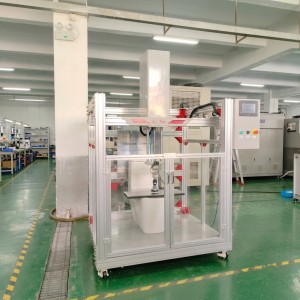
A WC pan that survives a seated person is not the same as one that survives installation, transport, or a plumber leaning on it with a spanner. The gap between “it held a static load” and “it held every load it will actually see” is exactly what a sanitary ceramic load resistance test machine exists to measure.
Load is not one thing
The mistake most non-specialists make is treating “load resistance” as a single number. Vitreous china — the dense, glass-like body behind nearly every sanitary fixture — is strong in compression but brittle in tension. That asymmetry means the same total force can pass or fail a part depending on where and how it is applied.
Three load types matter in practice, and they break the part differently:
| Load type | What it simulates | Typical failure mode |
|---|---|---|
| Point load | A foot, a tool, a knee pressed on a rim | Local crack radiating from the contact point |
| Off-centre load | Leaning on one side of a basin or pan | Bending stress across the rim, crack at the weakest section |
| Distributed load | A seated body on a pan, items in a basin | Slow crack growth over repeated use |
Notice the word “repeated.” A wash basin tested once may pass, yet fail the thousandth time a heavy object is rested on its rim. Load resistance testing is therefore as much about where the crack starts as about the peak force.
Where strength actually lives
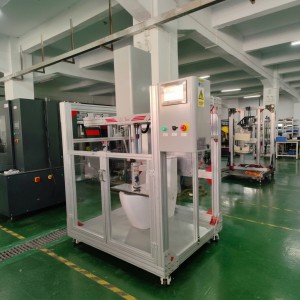
Ceramic fixtures fail at stress concentrations, not at their thickest wall. The real strength of a urinal or basin is governed by its geometry: how the rim transfers force into the body, how the mounting holes distribute the weight of the fixture itself, and how the part sits on its support surface.
This is the key insight a load resistance bench captures that a simple press cannot. A well-designed test rig loads the part through the same contact points the installer and the user will touch — not through an idealised flat plate. If the fixture is tested on a rigid, perfectly level bed while the real world mounts it on three wall anchors, the test says nothing about the true failure path.
Why a dedicated machine, not a universal press
A generic compression tester applies one downward force. A sanitary ceramic load resistance test machine is built around the fixture’s actual anatomy:
- Adjustable loading heads that mimic a rim, a seat, or a single point of contact;
- Controlled support fixtures that reproduce wall-mount versus floor-mount installation;
- Programmable load cycles that separate one-off strength from fatigue over repeated use.
The point is not that a universal press is incapable — it is that reproducing the right load path is the part of the test that separates a meaningful result from a meaningless one.
Standards frame the question, not the answer
Buyers across Europe and North America encounter load requirements through EN 997 for WCs and GB 6952 for sanitary ware generally. These standards define the load magnitudes, the loading positions and the acceptance criteria. They do not, however, tell you which machine reproduces them faithfully — that judgement stays with the test engineer and the equipment.
For export-facing manufacturers, the practical question is whether the bench can be reconfigured across the fixture family — pan, basin, urinal — without buying a separate machine for each. A Lituo bench aimed at this market is specified around that flexibility, so one investment covers a full catalogue.
What a single test can and cannot tell you
Load resistance testing proves that a fixture survives a defined load under defined conditions. It does not, by itself, prove dimensional stability, glaze integrity, or long-term watertightness. Those are separate tests. Conflating them — reading a pass on load as a pass on everything — is how a batch that should have been caught reaches the container.
What does “load resistance” mean for sanitary ceramic?
It is the fixture’s ability to withstand applied force without cracking or permanent damage, measured under specific loading positions defined by the relevant standard.
Is a point load or a distributed load more demanding?
Neither is universally harsher. Point loads concentrate stress and crack locally; distributed loads accumulate fatigue over repeated cycles. Both must be tested.
Does one machine cover pans, basins and urinals?
Only if it has adjustable heads and reconfigurable supports. A machine designed for one fixture geometry will not faithfully reproduce the load path of another.
Which standards should I reference?
EN 997 and GB 6952 are the common references, with region-specific variants. Confirm the exact clause and current revision for your target market before specifying limits.
Post time: Nov-03-2026


