


A sofa that passes its seat test and its back test separately can still crack the first time a person sits and leans back at the same time. That is the central reason a sofa durability tester offers combined loading, not just individual loading. The failure that matters most only exists when the seat and back are loaded together.
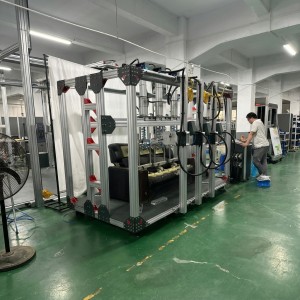
Separate Tests Measure Parts; Combined Tests Measure the Sofa
When the seat is pressed alone, the load travels a predictable path: cushion, spring, frame, floor. When the back is pressed alone, the load travels back through the frame to its anchors. Each separate loading checks one path in isolation, and a sofa can pass both while the two paths never interact.
The moment the seat and back are loaded together, a third path appears. The seated weight and the leaning force meet at the joint where the back meets the seat — the very connection point that neither single test reached. This is where upholstered furniture fails in the field, and where a combined test earns its cost.
The Internal Load Path That Single Tests Cannot See
Think of the sofa as a triangle: the seat, the back and the frame form a load-carrying structure. Pressing only the seat loads one side; pressing only the back loads another. But sitting and leaning back at once closes the triangle, and the force that was previously carried straight down now has a horizontal component running through the frame and the seat-back joint.
That internal load path is the difference. It is not a bigger force — the total load is the same — but a redirected one. The frame and its fasteners see shear and moment that the separate tests never introduced, and that is precisely why combined loading finds failures the individual tests miss.
What the Machine Actually Controls
Three stations allow one-, two- and three-seat sofas to be tested, with each station’s seat and back either run alone or together. Two high-accuracy load cells — one for the seat, one for the back — record the force with a display resolution fine enough to catch drift. Seat position adjusts side to side, and back position adjusts both side to side and up and down, so the pad lands on the same point the standard specifies rather than somewhere close to it.
PLC and touch-screen control run the sequence and keep an independent count per station, up to 999,999 cycles. That per-station counting matters more than it first appears: when three sofas run side by side, a single total count would hide which station failed first. Independent counting lets a report say exactly when and where a failure appeared.
Combined vs Separate: What Each Is For
| Separate loading | Combined loading | |
|---|---|---|
| What it checks | One load path in isolation | The interaction of seat, back and frame |
| Failure it finds | Cushion collapse, back anchor fatigue | Seat-back joint shear, frame moment |
| When to use | Component screening, material change | Full-structure qualification |
| Standard role | Basis for individual ratings | Closest to real use |
How the Standard Frames Durability
QB/T 1952.1 for upholstered sofas specifies the seat and back durability tests — the load, the angle and the cycle count — and the current edition tiers the requirements by quality grade. The machine’s job is to deliver those conditions faithfully, with a force reading accurate to the stated tolerance and a cycle count that is traceable. As always, exact figures should be confirmed against the current edition before a report is signed; this article deliberately avoids quoting values that a revision could change.
The Boundary: What Durability Testing Does Not Prove
A sofa that passes every durability cycle is still not proven against a single heavy impact — a person dropping onto the seat from a height is an impact test, not a fatigue test. Nor does durability testing cover the flammability, chemical or dimensional checks that a full sofa qualification requires. The durability tester answers one question — will the structure survive repeated, realistic use — and it answers that question better when it loads the seat and back together, the way a real person does.
Why does a sofa fail faster when seat and back are loaded together?
Combined loading closes the load triangle formed by the seat, back and frame. The seated weight and leaning force meet at the seat-back joint, creating shear and moment that neither single test introduces.
Can a sofa pass separate seat and back tests and still fail?
Yes. Separate tests each check one load path in isolation; the seat-back joint is only exercised when both are loaded together, so a weakness there can survive both individual tests.
Why does the machine count cycles per station independently?
When three sofas run side by side, a single total count would hide which station failed first. Independent per-station counting records exactly when and where a failure appeared.
Post time: Nov-18-2026


