


Ask ten buyers what a temperature and humidity chamber does, and nine will answer “it tests heat, cold, dry and damp.” That is true and also beside the point. The four ratings — heat resistance, cold resistance, dry resistance and damp resistance — all reduce to a single, sharper question: how precisely the chamber holds a temperature and a humidity over time, and how evenly it holds them across the space.
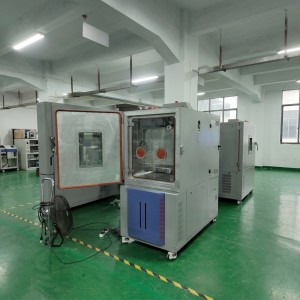
The four ratings are one mechanism
A material’s heat resistance is not measured by “how hot the chamber can go.” It is measured by holding the sample at a defined temperature long enough to reveal ageing, softening or failure. Cold resistance is the same test run at the other end of the scale. Dry and damp resistance are the same logic applied to humidity. In every case, the result depends on the chamber holding the condition, not merely reaching it.
This is why an environmental test chamber is judged on control, not on headline numbers. A chamber that reaches 150 °C but drifts by several degrees while the sample is inside is producing a different test from the one the standard specifies.
Two numbers decide whether the test is real
Two specifications matter more than the temperature range itself:
- Temperature uniformity — how close the temperature is between any two points in the workspace. If one corner of a sample sits several degrees hotter than another, the test measures an average that does not exist in reality.
- Temperature fluctuation — how much the chamber drifts around the set point over time. A slow wander, invisible on a single glance, quietly turns a constant-temperature test into a cycling one.
The same pair of questions applies to humidity. A chamber whose humidity range is quoted as “20–98% RH” is only useful if it can hold a chosen value within a defined tolerance, at the temperature where the test actually runs.
The working envelope is smaller than the spec sheet
Every chamber has a headline temperature and humidity range, and every chamber has a smaller region where both can be controlled together. At low temperature, humidity control typically stops — near or below freezing, the moisture the chamber would use to humidify simply condenses or freezes. At high temperature, the achievable humidity ceiling drops. A test point that falls outside this working envelope cannot be run, however impressive the headline range looks.
| Condition | What typically happens |
|---|---|
| Near or below 0 °C | Humidity control is suspended; only temperature is controlled |
| High temperature | Maximum achievable humidity falls below the headline value |
| Low temperature, high humidity | Condensation risk — the test point may sit outside the envelope |
This is the practical question a buyer should ask before purchase, and the one a competent supplier should answer honestly: what is the chamber’s combined temperature–humidity envelope, not just its two separate ranges.
Where the standards draw the line
The work a chamber is expected to do is framed by GB/T 2423 and IEC 60068 for environmental testing of electrical and electronic products, with constant and cyclic damp-heat procedures defined by their respective parts. A chamber built to these references is validated against the conditions those procedures demand — which is precisely why the uniformity and fluctuation specifications, not the peak temperature, carry the real weight.
For a Lituo chamber aimed at manufacturers across electronics, automotive and materials, the practical question is whether the machine holds a specified condition repeatably, batch after batch. That repeatability — not the number printed on the brochure — is what makes a reliability claim defensible.
Do heat, cold, dry and damp resistance need four different machines?
No. They are four conditions delivered by one chamber. What matters is how precisely the chamber holds each condition, not how many machines you own.
Which specification matters most?
Temperature uniformity and fluctuation, and their humidity equivalents. A chamber that drifts or heats unevenly is not running the test its standard specifies.
Why does humidity stop working at low temperature?
Because near or below freezing, the moisture used for humidification condenses or freezes, so humidity can no longer be controlled. The working envelope excludes that region.
Which standards should I reference?
GB/T 2423 and IEC 60068 for environmental testing, with their constant and cyclic damp-heat parts. Confirm the current edition and the exact procedure before specifying limits.
Post time: Nov-11-2026


