


A chamber that holds a material at −60 °C and another that holds it at +150 °C are both useful — but neither is a thermal shock test chamber. The damage thermal shock reveals comes not from the extreme temperatures themselves, but from how fast a sample jumps between them. The transition is the test; the temperatures are only its endpoints.
Shock is a rate, not a temperature
When a material is heated or cooled slowly, its layers expand or contract together, and internal stress stays low. When the same change happens in seconds, the surface moves faster than the core, and the resulting thermal expansion mismatch tears at interfaces — a solder joint, a laminate, a metal-to-plastic bond. A slow soak would never find that failure; a fast transition will.
This is why thermal shock is specified by transition time and recovery time, not by the endpoint temperatures alone. A chamber that takes ten minutes to swing from hot to cold is not a shock chamber; it is a fast temperature-cycling chamber. The distinction is the entire point.
How a three-zone chamber delivers the shock
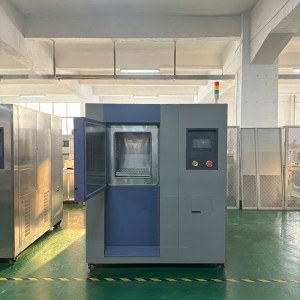
A three-zone type chamber separates the machine into a hot zone, a cold zone, and a test zone between them. The hot and cold zones hold their temperatures continuously; the sample sits still in the test zone, and a damper system switches which air stream floods it. The sample never moves.
That last detail matters more than it sounds. A moving-basket two-zone design transfers the sample between chambers, but the transfer itself adds mechanical vibration. A three-zone chamber keeps the sample stationary, so the only stress it sees is thermal — which is precisely the stress the test is meant to isolate. For vibration-sensitive parts like sensors, MEMS and crystal oscillators, that is the difference between a meaningful result and a contaminated one.
| Parameter | Why it defines the test |
|---|---|
| Transition time | How fast the sample jumps between extremes — the source of the stress |
| Recovery time | How fast the zone returns to set point after the switch — whether the shock is clean |
| Hot / cold zone capacity | Whether the zones can hold their temperature while delivering the shock repeatedly |
| Cycle count | How many shocks a part survives — the cumulative fatigue of repeated transitions |
What it separates, and what it finds
Thermal shock is a screening tool as much as a qualification tool. Across electronics, automotive and aerospace, a rapid series of hot–cold transitions exposes the latent failures that a soak or a slow cycle would miss: a cracked solder joint, a delaminating laminate, a seal that opens under thermal mismatch. Manufacturers use it to find early-life defects before a customer does, and to feed the result back into material and process improvement.
The same logic extends to the materials named in the product brief — metals, plastics, rubber and composites — where the chemical and physical damage from repeated expansion and contraction is exactly what a Lituo bench is specified to reproduce and quantify.
Where the standards draw the line
Temperature change testing is framed by GB/T 2423.22, which corresponds to IEC 60068-2-14, with its variants for rapid temperature change and two-liquid-bath methods. The standard defines the severity levels — the temperature extremes, the dwell times and the number of cycles — while the chamber’s transition and recovery performance determines whether those severity levels are actually delivered.
For export work, the practical question is whether the chamber’s transition time and recovery time are measured under load, not on an empty chamber. A machine that recovers in five minutes empty but drifts badly with a real sample inside is not delivering the shock its brochure promises.
Is thermal shock the same as temperature cycling?
Not exactly. Shock is defined by rapid transition, cycling by a controlled slower rate. The fast transition is what creates the thermal-expansion stress that shock is meant to expose.
Why does the three-zone sample stay still?
Because a stationary sample sees only thermal stress, with no mechanical vibration from being moved between chambers — essential for vibration-sensitive parts.
Which parameter matters most?
Transition time and recovery time, measured under load. The endpoint temperatures are only meaningful if the chamber can switch between them fast enough to create a real shock.
Which standards should I reference?
GB/T 2423.22 and IEC 60068-2-14 for temperature change, with their rapid-transition variants. Confirm the current edition and severity level before specifying limits.
Post time: Nov-13-2026


