



Bringing the Arctic and Desert into Your Lab: The Power of Walk-in Environmental Chambers
How do you test an aircraft avionics bay, a full vehicle dashboard assembly, or a pallet of server racks for deployment from Siberia to the Sahara? Standard bench-top chambers hit a literal wall. The solution is a controlled environment you can literally walk into. A Walk-in Constant Temperature and Humidity Test Chamber is not merely a scaled-up version of a desktop unit; it is a fundamental engineering infrastructure that enables comprehensive environmental simulation for large products, bulk materials, and complete systems. As your product description notes, it is indispensable across aerospace, automotive, and electronics for validating performance under extreme thermal stress, making it the cornerstone of global product qualification and large product reliability testing.
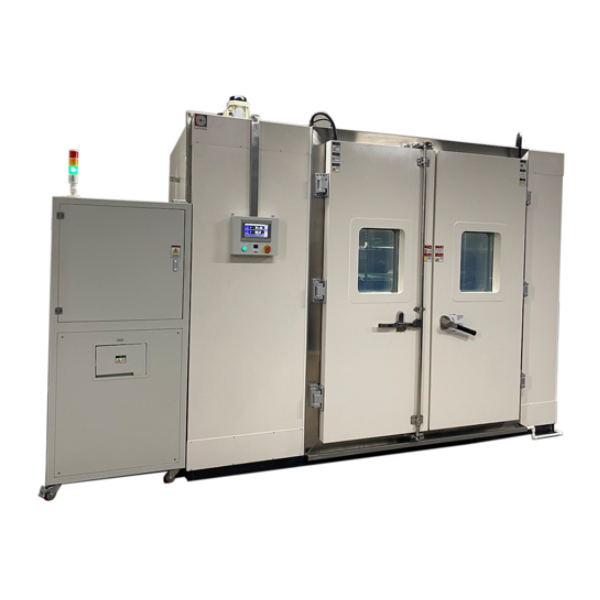
What is a Walk-in Constant Temperature and Humidity Test Chamber?
A Walk-in Constant Temperature and Humidity Test Chamber is a room-sized environmental simulation facility with a fully insulated structure, an airtight door, and a powerful, computer-controlled conditioning system. It creates precisely defined climatic conditions—from deep freeze to extreme heat, and from dry desert air to tropical humidity—within a volume large enough for personnel to enter for sample setup, monitoring, and adjustment. This capability allows for the testing of complete vehicles, large industrial equipment, or high-volume batches of components in their operational or storage configuration, enabling true environmental simulation at a system level. It is the definitive tool for high-low temperature test sequences and long-duration stability studies required by high-stakes industries.
Core Engineering: Building a Controllable Mini-Climate
Constructing a stable mini-climate at this scale requires robust, industrial-grade systems:
- High-Capacity Refrigeration & Heating: Utilizes cascade compressor systems or liquid nitrogen injection for rapid pull-down to as low as -70°C, and high-power electric heaters for temperatures exceeding +150°C.
- Industrial Humidification & Dehumidification: Employs high-output steam generators and dedicated cooling coils to achieve wide humidity ranges (e.g., 20% to 98% RH) uniformly across the large space.
- Advanced Airflow Management: Multiple high-volume fans and carefully engineered ductwork ensure temperature uniformity (±2°C or better) and humidity uniformity (±3% RH) throughout the entire walk-in volume, preventing stagnant zones.
- Robust Construction & Safety: Features include heavy-duty steel framing, high-performance insulation (PIR foam), sealed double-pane observation windows, safety door releases, interior lighting, and environmental monitoring for personnel safety.
Critical Applications Across Demanding Industries
The versatility of the walk in stability chamber makes it essential for validating products destined for any environment on Earth or beyond:
- Aerospace & Defense: Subjecting satellite components, radar units, or entire avionics racks to the extreme temperature vacillations of high-altitude flight and space. This is critical for aerospace component testing and MIL-STD compliance.
- Automotive: Testing complete electric vehicle battery packs, interior dashboards, or LED lighting systems for thermal performance, fogging resistance, and material durability under prolonged heat/cold soak.
- Electronics & Telecommunications: Performing High-Temperature Operating Life (HTOL) tests on batches of servers or conducting environmental stress screening on large quantities of PCBs to precipitate early-life failures.
- Energy & Materials: Evaluating the long-term stability of large composite wind turbine blades, solar panel arrays, or battery storage systems under cyclic environmental loads.
The Standardized Testing Protocol for Large-Scale Validation
Conducting tests in a walk-in chamber involves meticulous planning due to the scale:
- Test Profile & Load Planning: Engineers design a temperature/humidity cycle (e.g., 24-hour diurnal cycle). The thermal mass and power dissipation (heat load) of all products inside are calculated to ensure the chamber can handle it.
- Sample Layout & Instrumentation: Products are arranged on shelves or carts to ensure unobstructed airflow. Sensors are placed on and within test items, with cables routed through sealed ports to external data loggers.
- Chamber Conditioning & Stabilization: The door is sealed, and the chamber begins its program. Due to the large volume, reaching setpoints and achieving full uniformity may take significantly longer than in a benchtop chamber.
- Long-Duration Exposure & Remote Monitoring: Tests may run for days, weeks, or months. Conditions and sample data are monitored remotely via networked control systems, with alarms for any deviation.
- Post-Test Analysis: After exposure, products undergo functional testing and rigorous inspection for failures like material cracks, electronic drift, or condensation-induced corrosion.
The Strategic Business Case for a Walk-in Chamber
Investing in a walk-in chamber is a significant capital decision that delivers profound strategic advantages:
- Enable System-Level Reliability Engineering: Test complete assemblies to uncover integration issues—like mismatched thermal expansion between parts—that component-level tests would miss, preventing costly system integration failures.
- Dramatically Increase Testing Throughput & Efficiency: Test dozens or hundreds of components simultaneously under identical, controlled conditions, accelerating time-to-market for high-volume products.
- Meet the Most Stringent Compliance Mandates: Provide the certified testing environment required for industry-specific standards (e.g., RTCA DO-160 for aviation, IEC 60068 for electronics), which is often a contractual prerequisite.
- Establish a Center of Excellence: A walk-in chamber serves as a flagship capability, demonstrating a deep commitment to quality, attracting high-caliber engineering talent, and building trust with demanding clients in regulated industries.
Key Selection Criteria for Your Environmental Test Facility
Selecting the right Walk-in Constant Temperature and Humidity Test Chamber requires a forward-looking assessment of needs:
- Internal Volume & Future-Proofing: Choose a size that not only fits current products but also accommodates foreseeable future projects. Consider ceiling height and door dimensions for easy loading.
- Performance Specifications: Define the required temperature and humidity ranges, as well as the desired rate of change (standard vs. thermal shock capabilities). Uniformity specs are critical for large spaces.
- Construction & Utility Requirements: Evaluate floor load capacity, need for a raised floor or drainage, and utility connections (high-power electrical, chilled water, compressed air, LN2/CO2).
- Control System & Data Integrity: The controller must handle complex, long-duration profiles and provide secure, remote monitoring and data logging for unattended operation.
- Total Cost of Ownership (TCO): Factor in not just purchase price, but installation costs, energy consumption, and long-term maintenance/service contracts.
Conclusion: The Foundational Asset for Global Product Confidence
A Walk-in Constant Temperature and Humidity Test Chamber is more than a piece of test equipment; it is a foundational strategic asset for any organization engineering products for a global, demanding world. It represents the ultimate tool for risk elimination, transforming environmental unknowns into quantified, managed variables. By investing in this capability, companies empower their engineering teams to design with confidence, certify with authority, and deliver products with proven resilience. In an era where reliability defines market leaders, the walk-in chamber stands as a tangible commitment to excellence, ensuring that products will perform as promised—from the depths of winter to the heat of launch—securing both customer trust and competitive advantage.
Post time: Dec-30-2025


