


A water nozzle looks simple, but its “performance” is actually a bundle of seven different measurements carried out at once: flow rate, flow uniformity, water-efficiency grade, single-handle dual-control sensitivity, static-pressure sealing, dynamic-pressure sealing, and switch sealing. A Water Nozzle Comprehensive Performance Testing Machine exists to measure all of them in one reproducible test sequence, so a manufacturer can prove compliance before shipping to a market that enforces water-efficiency and sealing regulations.
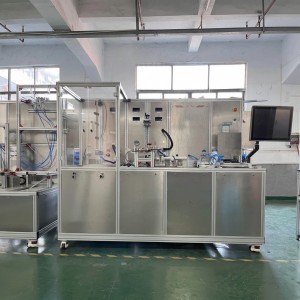
What Does a Water Nozzle Comprehensive Performance Testing Machine Measure?
- Flow rate: measured across a 0.13–2.4 m³/h range.
- Flow uniformity: verifies consistent output across the nozzle face.
- Water-efficiency grade for faucets: the metric many markets now regulate directly.
- Single-handle dual-control sensitivity: how predictably the handle responds.
- Static-pressure sealing: leakage under a fixed applied pressure.
- Dynamic-pressure sealing: leakage while water is flowing.
- Switch sealing: sealing integrity at the open/close mechanism.
Which Standards Apply to Water Nozzle Testing?
- Water-efficiency grading follows national water-efficiency standards for faucets (水嘴水效标准), which set maximum-flow thresholds per grade.
- Static and dynamic sealing tests align with the sealing requirements found in faucet and sanitary-ware standards such as GB/T 18145 and related EN/ASME faucet specifications.
- The machine is built to deliver the pressure and flow control precision these standards require, with a pressure sensor of 0.5 accuracy level and a flow accuracy of 0.5 level.
Key Technical Parameters
- Pressure sensor: 0–4 MPa range, accuracy level 0.5.
- Flow testing range: 0.13–2.4 m³/h, accuracy level 0.5.
- Maximum sensitivity test: 18 L/min at 0.3 MPa.
- Temperature control: hot water from room temperature to 80 °C; cold water from 10 °C to room temperature. Temperature sensor 0–100 °C, accuracy level 0.5.
- Angle/displacement accuracy: 1 degree; displacement 0.5 mm/s or 0.8 mm/s with accuracy 0.5 mm or better.
- Workstations: 2 stations for parallel testing.
Why Water-Efficiency Grade Matters More Than Ever
- Water-efficiency grading caps flow per grade; a machine with 0.5-level flow accuracy produces data repeatable enough to support a grade claim.
- Verifying flow uniformity and maximum flow at 0.3 MPa (the 18 L/min sensitivity reference) matches the conditions used in water-efficiency grading.
- A documented test report gives importers and certification bodies a traceable basis for acceptance.
How Static and Dynamic Sealing Differ
- Static-pressure sealing: apply a fixed pressure with flow stopped, and confirm no leakage at the seal.
- Dynamic-pressure sealing: confirm the seal holds while water flows through the nozzle.
- Switch sealing: exercise the open/close mechanism and confirm the valve seat stays tight after repeated operation.
- The 0–4 MPa pressure range and 0.5-level sensor provide the control resolution these three sealing tests demand.
How to Choose a Water Nozzle Test Machine
- Confirm coverage: the machine should test flow, uniformity, efficiency grade, sensitivity, and all three sealing modes in one unit.
- Check accuracy: pressure and flow at 0.5 level or better support reproducible grading data.
- Match temperature needs: hot-water (up to 80 °C) and cold-water (down to 10 °C) capability covers mixed-supply nozzle tests.
- Size the workstations: 2 stations raise throughput for routine QC and batch inspection.
Frequently Asked Questions
What is a Water Nozzle Comprehensive Performance Testing Machine used for? It measures a water nozzle’s flow rate, flow uniformity, water-efficiency grade, single-handle dual-control sensitivity, and static/dynamic/switch sealing in one automated test sequence.
What flow range does it cover? 0.13–2.4 m³/h with accuracy level 0.5.
Can it test both hot and cold water? Yes. Hot water runs from room temperature to 80 °C and cold water from 10 °C to room temperature.
How many nozzles can it test at once? Two workstations allow two nozzles to be tested in parallel.
Post time: Nov-26-2026


