


Sanitary ceramics such as toilets, urinals, and squatting toilets are used every day in homes, hotels, offices, hospitals, commercial buildings, and public facilities. Although these products may appear relatively simple, their performance involves several important factors, including flushing performance, water consumption, flow rate, water pressure, and overall hydraulic performance.
A product that looks good and functions normally during a basic inspection does not necessarily perform consistently under different water pressure and flow conditions. This is why comprehensive performance testing has become an important part of sanitary ceramics quality control.
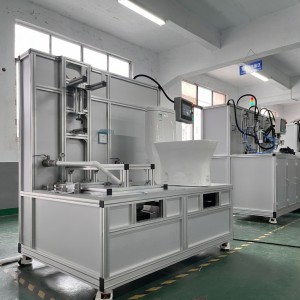
1. What Is Sanitary Ceramics Performance Testing?
Sanitary ceramics performance testing is a systematic evaluation of the hydraulic and functional performance of sanitary ceramic products.
For toilets, urinals, and squatting toilets, testing can help manufacturers understand how the product performs under controlled water supply conditions.
Typical test items include:
- Flushing performance
- Water efficiency
- Water consumption
- Flow rate
- Static water pressure
- Dynamic water pressure
- Flushing time
- Water discharge performance
The purpose is not simply to determine whether a product can flush. More importantly, testing helps determine whether the product can maintain stable performance under specified conditions.
2. Why Is Flushing Performance Important?
Flushing performance is one of the most important functional characteristics of a toilet or other flushing sanitary ceramic product.
If the flushing system does not provide sufficient hydraulic performance, users may experience incomplete flushing, poor cleaning, excessive water consumption, or the need for repeated flushing.
On the other hand, simply increasing water flow does not necessarily produce better performance. A well-designed product needs to achieve an appropriate balance between flushing effectiveness and water efficiency.
Laboratory testing provides manufacturers with quantitative data that can be used to evaluate and optimize this balance.
3. Water Pressure Can Affect Test Results
Water pressure is an important variable in sanitary ceramics testing.
Different installation environments may have different water supply conditions. If a product is only tested under one uncontrolled water pressure condition, it can be difficult to determine whether its performance is stable.
A Sanitary Ceramics Performance Testing Machine can provide controlled pressure conditions and measure both static and dynamic water pressure.
For example, the testing system can provide:
- Static pressure range: 0–1.0 MPa
- Dynamic pressure range: 0–0.6 MPa
- Pressure accuracy: Class 1.0
This allows manufacturers to conduct repeatable tests and compare performance between different product designs.
4. Flow Rate and Water Consumption Need to Be Measured
Water efficiency is becoming increasingly important in modern sanitary ceramics product development.
A toilet that consumes excessive water may increase operating costs, while insufficient water flow may negatively affect flushing performance.
Therefore, flow rate and water consumption testing can provide important information for product optimization.
The testing equipment can be configured with flow measurement ranges of:
0–50 L/min
and
0–300 L/min
with an accuracy of ±0.5% of full scale.
Quantitative flow data allows manufacturers to compare different designs and determine whether changes to the flushing structure improve performance without unnecessarily increasing water consumption.
5. Why Test Different Types of Sanitary Ceramics?
Sanitary ceramics are not limited to conventional toilets.
Different products have different hydraulic structures and operating requirements, including:
- Toilets
- Urinals
- Squatting toilets
A comprehensive testing system can be configured for different product types, allowing manufacturers to evaluate multiple products within the same laboratory environment.
This is especially useful for companies with a broad sanitary ceramics product range.
6. Testing Helps Identify Problems During Product Development
One of the biggest benefits of comprehensive testing is that it can be performed before mass production.
During product development, engineers can use test results to identify problems such as:
- Insufficient flushing performance
- Excessive water consumption
- Unstable water pressure
- Abnormal flow rate
- Inconsistent flushing behavior
- Poor hydraulic design
The design can then be modified and tested again.
This creates a practical development cycle:
Design → Testing → Data Analysis → Optimization → Retesting
Compared with discovering problems after mass production, identifying weaknesses during the development stage can significantly reduce modification costs and quality risks.
7. Testing Supports Consistent Product Quality
Comprehensive performance testing is also important after a product enters mass production.
Even when the product design remains unchanged, variations in raw materials, manufacturing processes, molds, assembly, and component suppliers can affect final performance.
Regular testing can help manufacturers compare different production batches and identify abnormal changes.
For example, if the measured flow rate or flushing performance of one batch differs significantly from previous batches, the quality team can investigate the relevant manufacturing process.
This makes testing an important part of sanitary ceramics quality control rather than simply a certification procedure.
8. Supporting International Market Requirements
Sanitary ceramics manufacturers serving international markets often need to consider different technical requirements and testing procedures.
The Comprehensive Sanitary Ceramics Performance Testing Machine can be configured for testing associated with requirements such as ASME A112.19.2.
Before conducting compliance testing, manufacturers should always confirm the latest applicable standard, test method, and specific product requirements for the target market.
Reliable laboratory equipment can help manufacturers establish controlled and repeatable test conditions before formal third-party testing.
9. Why Use a Comprehensive Testing Machine?
Using separate equipment for pressure, flow, water consumption, and other tests can increase product handling and make laboratory testing more complicated.
A comprehensive testing system integrates multiple measurement functions into one platform.
The equipment can provide:
- Pressure measurement
- Static pressure testing
- Dynamic pressure testing
- Flow measurement
- Water-related performance evaluation
- Timing control
- Weight measurement
The system can also be configured with two test stations, including a station for squatting toilets and urinals and another for toilets.
This can improve testing efficiency and make laboratory workflows more consistent.
Conclusion
The necessity of sanitary ceramics comprehensive performance testing comes from one basic requirement: a sanitary ceramic product must provide stable, efficient, and reliable performance throughout its service life.
For manufacturers, visual inspection alone cannot fully evaluate flushing performance, water efficiency, pressure response, and flow characteristics.
By using a Comprehensive Sanitary Ceramics Performance Testing Machine, manufacturers can obtain measurable data on flushing performance, water pressure, flow rate, and water consumption. These results can support product development, quality control, design optimization, and international market testing.
Ultimately, comprehensive testing is not only about determining whether a sanitary ceramics product passes a test. It is about using reliable data to build better-performing, more water-efficient, and more consistent sanitary ceramics products.
Post time: Oct-14-2026


