


Armrests, seat pans and footrests all fail the same way: not in one spectacular moment, but after thousands of small loads applied in an awkward direction. That similarity is the commercial argument for one bench instead of three.
This article explains what armrest fatigue testing measures, how a single adjustable rig can cover three parts, and which specification details decide whether the saving is real.
Key takeaways
- The load is applied at 10° from vertical, not horizontally — the angle is part of the test, not a setup preference.
- A pneumatic cylinder with adjustable mounting direction is what turns one bench into three applications.
- Cycle counting alone proves nothing; the bench must detect loss of load or stroke.
- Multi-function does not replace impact or static load testing — it sits alongside them.
The primary test: cyclic side load on the armrest
A person rising from a chair pushes down and outward on the armrest. That is not a vertical load and it is not a pure horizontal one; it is oblique, and the standards fix the obliquity so laboratories can compare results.
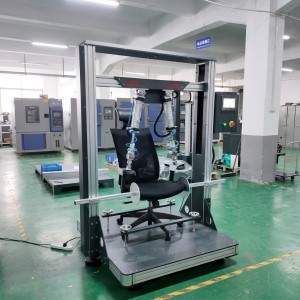
Hence 10° from vertical. The office chair armrest is clamped in a fixture, a pad is positioned at the specified point, and the pneumatic cylinder applies a repeated cyclic side load until a defined cycle count is reached or the sample fails.
The choice of 10° also explains why a rig built for horizontal push tests cannot be substituted. The bending moment at the armrest bracket changes with load angle, and so does the failure location — an armrest that survives 50,000 horizontal cycles may crack at the mounting plate within a fraction of that when pushed obliquely.
Extension one: the seat pan
Reorient the cylinder and the same frame loads a seat surface vertically or at a forward angle. The fixture changes, the drive does not.
This matters because seat fatigue and armrest fatigue are usually needed at the same time on the same product. Running them on separate machines means two chairs, two mounting operations and two sets of datum errors.
Extension two: the footrest
Footrests and leg rests take a smaller absolute load but a higher cycle count relative to their strength, and they are frequently the first part to work loose.
Here the geometry of a multi-angle rig is the whole point: a footrest is loaded from above and outward, a foot pad on a drafting chair from a different direction again. An adjustable cylinder mount covers both without a dedicated machine.
Why the angle adjustment is the actual product
In a single-angle tester, the frame is the cost and the fixture is the accessory. In a multi-function bench, the adjustable mount is the engineering: it has to hold position under repeated load without creeping.
Creep is the failure mode to ask about. A cylinder bracket that drifts two degrees over 20,000 cycles changes the load vector silently, and the resulting report describes a test nobody specified.
| Test | Load direction | Typical failure observed |
|---|---|---|
| Armrest fatigue | 10° from vertical | Bracket cracking, insert pull-out, pad delamination |
| Seat fatigue | Vertical to forward-oblique | Pan cracking, foam collapse, frame weld fatigue |
| Footrest fatigue | Downward and outward | Hinge loosening, tube deformation, fastener back-out |
Load values, cycle counts and pass criteria are set by the applicable standard — QB/T 2280, BIFMA X5.1, EN 1335 or GB/T 10357.3 — and differ between them. Take the figures from the current edition you declare.
What separates a usable bench from a cheap one
- Force calibration with a traceable load cell, because a pneumatic cylinder’s output drifts with supply pressure and seal wear.
- Loss-of-load and loss-of-stroke detection, so the counter stops when the sample collapses instead of recording cycles against thin air.
- Adjustable stroke and dwell, since a fast cycle reduces test time but changes how the material responds.
- Fixture modularity — armrest pads, seat plates and footrest clamps on one interface.
The third point deserves emphasis. Pneumatic actuation is inexpensive, robust and perfectly adequate for fatigue work, but speed and dwell have to be settable, otherwise one bench cannot serve both a 30-cycle-per-minute durability run and a slower programme that a European standard assumes.
What it will not do
A fatigue bench does not replace impact testing, static load testing or stability testing. It answers one question — will this part survive repeated service loads in this direction — and it answers it only for the directions it is set to.
That is not a limitation to apologise for. It is the reason fatigue data is credible: the load path is defined, the fixture is defined, and the result is reproducible in another laboratory.
Checklist before you order
- List every standard you must report against, then confirm the required load angles — they are not the same across regions.
- Ask for the fixture set for all three parts, priced in. Accessories quoted separately usually arrive one purchase order late.
- Confirm the cylinder mount can be locked and verified, not just loosened and re-tightened by feel.
- Require a demonstration on your own chair, with the report format you intend to issue.
Lituo has manufactured furniture and mechanical testing instruments since 2008. Its armrest fatigue testing machine applies cyclic side load at 10° from vertical to QB/T 2280, BIFMA X5.1, EN 1335 and GB/T 10357.3 programmes, and extends to seat pan and footrest testing by reorienting the pneumatic cylinder. View the furniture testing range →
Frequently asked questions
Can the same machine test armrests and seat pans?
Yes, with the appropriate fixtures and an adjustable cylinder mount. The frame and drive are shared; the fixture interface and load angle change.
Why is the load applied at 10° rather than horizontally?
Because it represents how users actually load an armrest when rising or leaning. The standards fix the angle so that results from different laboratories remain comparable.
Pneumatic or servo actuation?
Pneumatic is sufficient for most fatigue programmes and costs less to maintain. Servo is preferable where a defined load waveform or precise rate control is required.
How many cycles should the test run?
Follow the standard you declare, and state the count in the report. Where a customer specification is stricter than the standard, the stricter figure governs.
Post time: Nov-02-2026


