


The same chair can pass one standard and fail the other. Not because one laboratory is stricter, but because the two documents ask different questions — and each answer protects a different part of the product’s life.
For a manufacturer selling into both North America and Europe, that means chair seat impact testing is not one test run twice. It is two test philosophies applied to the same seat pan, and the results are reported in language that does not translate directly.

Key takeaways
- BIFMA X5.1 and EN 1335 both simulate abuse seating, but structure the requirement differently: cyclic durability with defined pass criteria versus static strength plus fatigue plus stability.
- A one-off impact measures energy absorption in milliseconds; a cyclic test measures cumulative damage. A chair can satisfy one and fail the other.
- Impact results are only comparable when impactor geometry, mass, drop height and mounting are reported alongside them.
- A single bench with both modes cuts handling error and halves the sample count for dual-market projects.
What each document is actually for
BIFMA X5.1 is the American national standard for general-purpose office chairs. It is a single document covering the whole chair — backrest, seat, arms, legs, casters, tilting mechanisms — with a mixture of static, impact and cyclic tests, and a pass criterion built around continued serviceability rather than permanent deformation alone.
EN 1335 is structured differently. In the 2000 edition, Part 1 sets dimensions and chair types, Part 2 sets safety requirements, and Part 3 sets the test methods that produce the evidence for Part 2. Strength, durability and stability are treated as separate claims, which is why a European technical file tends to be longer than an American one for an equivalent product.
Both are legitimate. The practical difference is that a BIFMA report answers “is this chair fit for office use”, while an EN 1335 file answers “which specific requirement does this chair meet, and how was it demonstrated”.
National adoptions of EN 1335 differ — BS EN, DIN EN and NF EN versions may lag the CEN edition. Always test and declare against the edition named in the purchase specification.
Two failure modes that must not be confused
A seat impact test is an energy event. A mass falls onto the seat surface and the seat must absorb that energy within milliseconds — through foam compression, pan deflection and frame compliance — without cracking, permanent set or joint separation.
Cyclic seat durability is a damage-accumulation event. The load is modest but repeated thousands of times, and failure appears where stress concentrates: weld toes, rivets, screwing points, the pan-to-frame interface.
The two are not interchangeable, and this is where specifications go wrong. A rigid seat pan may survive a single heavy impact and then fail fatigue at a bracket after a few tens of thousands of cycles. A compliant pan may absorb impact beautifully and progressively lose height under cyclic load, so the chair no longer meets its dimensional claim.
Testing both is not belt-and-braces. It is testing two different products: the chair as dropped on, and the chair as sat on for five years.
The requirement matrix
| Requirement | BIFMA X5.1 | EN 1335 (2000) |
|---|---|---|
| Seat static load | ✓ | ✓ |
| Seat one-off impact / drop | ✓ | ✓ |
| Seat cyclic fatigue | ✓ | ✓ |
| Backrest static and cyclic | ✓ | ✓ |
| Armrest and leg strength | ✓ | ✓ |
| Stability (front / side / rear) | ✓ | ✓ |
| Dimensional requirements | — | ✓ Part 1 |
| Separate test-method document | — | ✓ Part 3 |
Impactor mass and geometry, drop height, cycle counts and pass criteria are defined inside each document and revised between editions. They are deliberately not reproduced here — take them from the edition you declare, not from a summary.
Why one bench needs two modes
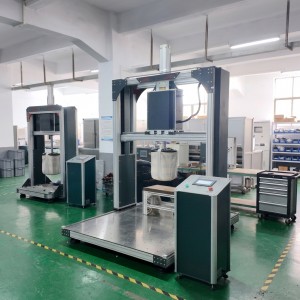
The chair seating impact and durability testing machine exists because these two events, though physically different, are applied to the same point on the same sample. Running them on separate rigs means re-clamping, re-datuming and, in most laboratories, a second chair.
A well-designed bench therefore combines an impact mode and a cyclic mode on one frame:
- Impact mode — a guided impactor released from an adjustable height onto the seat surface, simulating abuse seating. Height adjustment is what lets one machine cover both standard profiles without swapping hardware.
- Cyclic mode — a pneumatic or servo actuator applying a repeatable load profile to the seat, with a counter and automatic stop on cycle completion.
- Shared fixturing — the sample stays mounted between modes, so the datum does not shift and the second result is directly comparable to the first.
- Logged data — peak force, deflection and cycle count recorded per run, so the report can show a curve rather than a verdict.
Multi-station configurations matter for a different reason. Impact tests consume samples when they fail, and a two- or four-station bench lets a laboratory run a design iteration and a reference sample in parallel instead of in sequence.
What a defensible report contains
Impact numbers without context are not comparable between laboratories. A report that states only “passed” cannot be defended in a dispute, and cannot be used to reproduce the result.
At minimum it should record impactor geometry and mass, drop height, the mounting and support condition of the sample, the number of impacts applied, and the pass criterion used — including whether permanent deformation or loss of function was the deciding factor. For cyclic runs, add the load profile, the frequency and the total cycle count.
Specifying a bench for dual-market work
If a product range is sold in both regions, the bench should be specified against the harder of the two requirements, not the more familiar one:
- Adjustable drop height and a supplied impactor set, so the same frame covers both document profiles.
- Independent cyclic control with programmable load, frequency and count — not a fixed-speed timer.
- Rigid base and square mounting plate, because deflection measured on a compliant frame is a measurement of the bench, not the chair.
- Report templates that map to both declaration formats, so one test run can feed two technical files.
Lituo has manufactured material and mechanical testing instruments since 2008, and supplies furniture testing equipment to inspection institutes and chair manufacturers in Europe, North America and Southeast Asia. The chair seating impact and durability testing machine is part of a wider office chair testing equipment range, configurable by station count, control mode and data logging. View the furniture testing range →
Frequently asked questions
Can one test satisfy both BIFMA X5.1 and EN 1335?
Not as a single run. The parameters differ between the documents, so a dual declaration normally requires two test sequences — but they can share the same sample, fixture and bench.
Which test comes first, impact or cyclic?
Impact is usually applied first, because the cyclic run then reveals whether the impact left damage that only propagates under repeated load. Reversing the order hides exactly that failure mode.
Why does a chair pass static load and fail impact?
Static load tests stiffness and strength over time. Impact tests energy absorption over milliseconds, which depends on foam grade, pan geometry and joint ductility. A strong but brittle assembly can pass one and fail the other.
Does the standard specify the impactor, or does the laboratory choose?
The standard specifies it. Impactor geometry and mass are part of the test method, and substituting a different impactor invalidates the comparison even if the resulting number looks plausible.
Post time: Oct-23-2026


