


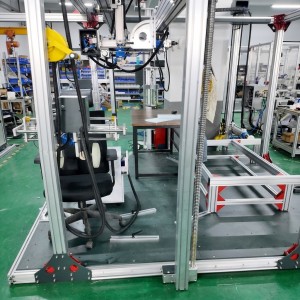
A table, a chair, a cabinet and a bed all get “strength and durability tested,” but the word means something different for each of them. A table fails by deforming, a chair fails by tipping over, a cabinet fails at its joints, and a bed fails in its frame. A furniture comprehensive testing machine is not a bigger press — it is a machine that knows which failure it is looking for.
One Standard Family, Four Failure Modes
The GB/T 10357 series organises furniture mechanical testing into parts, and the parts line up with the four categories: tables, chairs and stools, cabinets, and single-level beds. Each part specifies the same three broad checks — strength, durability and stability — but the check that actually decides a product differs from category to category.
That is the point most buyers miss. They ask “how much force can it apply?”, but the more useful question is “does it apply the right kind of force, at the right angle, against the right criterion, for each category?” A machine that only pushes down will test a table and nothing else well.
Tables: The Deformation Problem
A table fails when its top sags under load. The decisive measurement is deformation — how much the surface bends under a specified vertical load, and how much of that bending remains once the load is removed. Strength here is about stiffness, so the machine must apply a controlled vertical load to a precise point and record displacement, not just survival.
Chairs: The Tipping Problem
A chair rarely fails by collapsing; it fails by tipping over when a person leans back or to the side. The decisive check is stability — whether the chair stays upright under a forward, backward or lateral force. This is a different kind of test entirely: it is not about how much load the structure survives, but about whether the centre of gravity stays inside the base. Strength and durability still matter, but stability is the chair’s own failure mode.
Cabinets: The Joint Problem
A cabinet fails where the parts meet — the shelf supports, the drawer runners, the door hinges, and the frame itself. Its tests are the most numerous because a cabinet is a system of many loaded connections. And cabinets carry an extra safety dimension: a tall cabinet must not tip when its drawers or doors are open, so stability testing runs with the moving parts in their most dangerous position.
Beds: The Frame Problem
A bed fails in its frame and its slatted or solid base, under repeated loading and occasional impact. Durability here means the frame survives cycles of load without loosening, and the base survives an impact without a slat breaking through. The failure is structural fatigue, closer to the chair’s durability problem than to the table’s stiffness problem.
What the Machine Must Switch Between
Across these four categories, a comprehensive tester has to change three things, not one. First, the load type: a table needs a slow vertical press, a chair needs a horizontal push for stability, a bed needs cyclic loading. Second, the angle and position: the same force applied at a different height or angle is a different test. Third, the criterion: deformation for tables, tip-over for chairs, joint survival for cabinets, frame fatigue for beds.
A machine that applies force without switching these three is only ever really testing one category, no matter how many product names appear in its brochure.
Why One Machine, Not Four
The practical argument for a furniture comprehensive testing machine is consistency and cost. A single calibrated platform means the force sensor, the displacement reading and the control software are the same for every category, so results are comparable across a product range and a lab does not buy and maintain four separate rigs. The trade-off is that the machine must be genuinely adaptable — adjustable loading points, settable angles and programmable sequences — or the “comprehensive” claim is just a label.
The Boundary: What a Comprehensive Tester Does Not Cover
Covering four categories of mechanical testing does not cover everything. Surface finish, dimensional accuracy, flammability and chemical emissions are separate domains with their own standards and instruments. The comprehensive tester answers the mechanical question — strength, durability and stability — across tables, chairs, cabinets and beds. Knowing that boundary is what keeps a test report honest, and a quality programme from over-claiming.
Do tables, chairs, cabinets and beds fail the same way?
No. Tables fail by deforming under load, chairs by tipping over, cabinets at their joints, and beds in their frame under fatigue. Each category has its own decisive failure mode.
What does a comprehensive testing machine actually switch between categories?
Three things: the load type (vertical press, horizontal push, cyclic loading), the angle and position of the load, and the criterion used to judge pass or fail.
Why buy one comprehensive machine instead of four single-purpose rigs?
Consistency and cost. One calibrated platform keeps the force sensor, displacement reading and control software identical across categories, so results are comparable and the lab avoids maintaining four separate rigs.
Post time: Nov-23-2026


