


A faucet is the most actuated plumbing component in any building, yet most buyers never see it fail until long after installation. The only way to know whether a valve will hold its seal, its cartridge, and its thermostatic control over a realistic service life is to cycle it mechanically under controlled pressure, temperature, and torque. A Faucet & Tap Endurance Test Bench exists to answer one question with measurable evidence: how many open-close cycles will this faucet survive before it leaks, jams, or drifts out of specification?
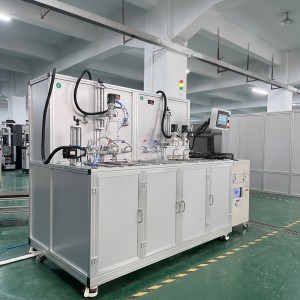
What Is a Faucet Endurance Test?
A Faucet & Tap Endurance Test Bench is an instrumented test system that repeatedly actuates a faucet’s handle, spout, or switching mechanism while holding water at defined pressure and temperature, and records when performance falls outside an accepted limit.
Core conclusion first: endurance testing does not predict an exact calendar lifetime. It quantifies cycle life under a standardized, reproducible condition, so a manufacturer or importer can demonstrate conformance to a named standard and compare designs on equal terms.
Key capabilities of a typical bench:
- Cycle single-control, dual-control, and double-handle faucets.
- Test thermostatic and non-contact (touchless) faucets.
- Cover pull-out faucets, rotating spouts, and shower-function switching.
- Record torque, force, displacement, flow, and temperature continuously.
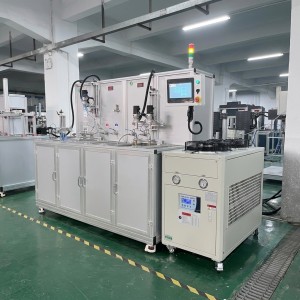
Which Standards Define Faucet Working Life?
Faucet endurance is defined by regional and international standards, each with its own cycle counts, pressures, and temperatures. A Faucet & Tap Endurance Test Bench is built to run against several of them on a single platform.
The commonly cited standards include:
- ASME A112.18.1 / CSA B125.1 — Plumbing supply fittings (North America).
- EN 200 — Taps and mixing valves for water supply systems.
- EN 817 — Mechanical mixers.
- EN 1111 — Sanitary tapware — thermostatic mixing valves.
- EN 246 — Flow rate regulators.
- GB 18145 / GB/T 41863 / CJ/T 194 — Chinese national and industry standards for ceramic cartridge faucets.
- AS 3718 (Australia), SANS 226 (South Africa), TISI 2067 (Thailand), SASO EN 246 (Saudi Arabia).
Why multiple standards matter: an exporter serving North America, Europe, and Southeast Asia needs evidence against each target market’s requirements. A bench that can run independent stations at different pressures and temperatures lets one machine produce conformance data for several standards without re-fixturing.
What Parameters Make the Test Reproducible?
Reproducibility — not raw cycle count — is what gives a test evidentiary value. The measurement chain determines whether the result can be defended in a certification audit.
Typical instrumented parameters on a Faucet & Tap Endurance Test Bench:
- Pressure: 0–1.0 MPa sensing at 0.2-class accuracy; pump pressure 0.02–1.0 MPa with ±0.05 MPa stability below 0.5 MPa.
- Flow: electromagnetic flow metering at 0.5 class, up to 50 L/min.
- Temperature: Class A sensors; cold water 5–30 °C and hot water ambient–90 °C, each controlled to ±2.5 °C.
- Torque: servo system 0–6 N·m at ±0.1 N·m (0.5 class), for cartridge and handle actuation force.
- Displacement: ±0.5 mm or ±0.5°, with action speeds adjustable from 0.5°/s to 65°/s.
The practical point: a torque reading of 0.1 N·m precision means the bench detects a cartridge that is beginning to bind or a handle that is loosening, long before a human operator would notice it. That early signal is what separates a pass from a costly field recall.
Why Test Thermostatic and Touchless Faucets Differently?
Standard mechanical faucets cycle under a simple open-close sequence, but two product classes need additional test logic.
- Thermostatic faucets (EN 1111) must maintain outlet temperature while hot and cold supplies fluctuate. The bench’s independent hot/cold supply with separate chiller and heater reproduces these fluctuations, and the result is a temperature-stability measurement, not just a cycle count.
- Touchless / non-contact faucets actuate by sensor rather than handle torque. The bench must trigger the sensor and verify response and shut-off, so the test covers electronics and solenoid valves in addition to the mechanical cartridge.
Conclusion: one test rig that covers both mechanical and electronic faucets reduces the number of separate machines a laboratory must buy and maintain.
How to Choose a Faucet Endurance Test Bench
Selection should follow the standards you must meet and the product range you manufacture or import.
- Confirm the standards first. A supplier serving the EU and North America needs ASME A112.18.1 / CSA B125.1 and EN 200 / EN 817 at minimum.
- Check the measurement class. 0.2-class pressure and 0.5-class flow give certification-grade data; approximate readings do not hold up in an audit.
- Verify multi-standard capability. Independent supply and control per station let several standards run simultaneously.
- Review mechanism coverage. Confirm the bench handles your specific configurations — double-handle, pull-out spout, shower-function switching — before purchase.
- Look at servo torque and auto-centring. A servo that auto-calculates the valve spindle angle removes manual setup error between operators.
Key Takeaways
- A Faucet & Tap Endurance Test Bench measures cycle life under controlled, repeatable conditions — it does not promise a calendar lifetime.
- Working life is defined by named standards (ASME A112.18.1/CSA B125.1, EN 200, EN 817, EN 1111, EN 246, GB 18145, and others), each with its own cycles, pressures, and temperatures.
- Reproducibility depends on the measurement chain: 0.2-class pressure, 0.5-class flow, Class A temperature, and ±0.1 N·m torque.
- Thermostatic and touchless faucets require distinct test logic — temperature stability and sensor response — beyond simple mechanical cycling.
- Multi-standard, multi-station capability lets one bench produce defensible conformance data for several export markets.
Post time: Nov-19-2026


