


Buyers often treat dust protection as a pass or fail. In the standards it is a ladder: one level tolerates dust inside the enclosure, the next admits none at all, and the gap between them is a vacuum pump, not a gasket.
This article walks that ladder from bottom to top, and explains what a sand and dust test chamber can and cannot demonstrate about a product.
Key takeaways
- IP5X is dust-protected, not dust-tight: dust may enter in quantities that do not impair operation.
- IP6X is dust-tight: no ingress at all, and the test normally requires a negative pressure inside the enclosure.
- The vacuum is the discriminating hardware — without it, a chamber can run an IP6X programme and prove nothing.
- Dust and sand are different tests for different threats: ingress versus abrasion.
Why dust protection is graded at all
Because zero ingress is expensive and often unnecessary. A street luminaire and a sealed automotive connector face the same powder, but only one of them fails if a gram of talc reaches an internal surface.
The IP code therefore separates IP5X from IP6X, and the separation is about consequence, not about quantity of powder in the air. That distinction is the whole substance of a dust test, and it is where most specification errors begin.
Level one — IP5X: dust-protected
In an IP5X test, the sample sits in a circulating talc powder atmosphere for a defined period. Powder will enter. That is expected and permitted.
The pass criterion is functional: no dust in a quantity that interferes with normal operation, no compromise of safety, no failure of insulation or contact. A device can therefore pass IP5X with visible powder inside the housing.
Under IEC 60529 and its national equivalents, the test atmosphere is normally talc powder in the order of 75 µm particle size at around 2 kg/m³ concentration, run for several hours. Confirm the figures against the current edition — they are frequently misquoted in procurement documents.
Level two — IP6X: dust-tight, and the vacuum that makes it real
IP6X permits no ingress. The critical difference is not the powder but the negative pressure: air is extracted from the enclosure during the test, so the internal pressure sits below ambient and any path that could leak will leak.
This is the physical point most buyers miss. A real product heats and cools in service, and that thermal cycling pumps air — and dust — through every imperfect joint. A static chamber test that does not depressurise the sample never reproduces the mechanism it claims to test.
Here is the honest limit of the bench: an IP6X pass means the enclosure resisted dust under a defined vacuum for a defined time. It does not prove the gasket will survive five years of thermal cycling, UV exposure and vibration. Passing a chamber test is evidence, not a warranty.
Where dust and sand part company
Talc is a fine, soft powder. It finds gaps, bridges filters and settles on surfaces where it can carbonise or conduct. That is an ingress problem.
Sand is coarse and hard. It erodes coatings, scores seals and abrades cable jackets. A product that is dust-tight can still be destroyed by sand, because the failure is mechanical wear rather than penetration.
So when a specification says “sand and dust”, check which one the standard actually requires. Running an abrasive sand programme to answer a dust-ingress question produces a report that satisfies nobody.
Why automotive parts cannot borrow a household standard
GB 4208 and IEC 60529 were written around enclosures of electrical equipment, and they suit appliances, luminaires and control cabinets well. Road vehicles are covered by a different document — ISO 20653 — which sets its own dust concentrations, cycle patterns and mounting conditions.
The consequences are practical. A component qualified to a household IP level may fail an automotive programme on cycle count alone, and a chamber built for appliance testing may not reproduce the vibration and temperature cycling that the automotive programme assumes.
One point worth verifying in your own documents: the automotive dust and water IP standard is ISO 20653. There is no IEC 20653, although supplier literature sometimes prints it that way — usually a transcription of GB/T or ISO references. Confirm the citation before it enters a technical file.
Four ways a dust test result becomes unusable
- Powder that has absorbed moisture. Damp talc cakes, stops circulating and under-tests the sample. Powder condition matters as much as concentration.
- Sample conditioning skipped. Seals behave differently at the temperature the standard specifies; testing a cold sample in a warm chamber changes the result.
- No recovery period. Opening the enclosure immediately after the run disperses powder that would otherwise have stayed put, and the inspection becomes guesswork.
- Subjective judgement without a record. ”No harmful ingress” needs photographs, a stated inspection method and a defined functional check, or it is one engineer’s opinion.
What to look for in a chamber
For a laboratory specifying equipment rather than a product, four features decide whether the bench can serve more than one market:
- Vacuum extraction with independent control, so IP6X programmes can set and hold a defined depression.
- Verifiable powder circulation — the ability to demonstrate concentration, not merely to fill a hopper.
- Programmable cycle profiles, because appliance and automotive programmes differ in duration and repetition.
- Access for inspection and cleaning, since cross-contamination between talc and sand runs invalidates both.
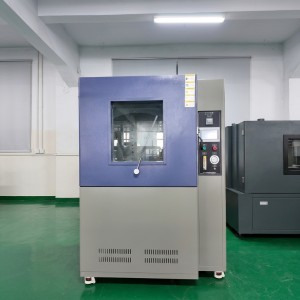
Lituo has manufactured environmental and mechanical testing instruments since 2008. Its sand and dust test chamber range supports IP5X and IP6X programmes for electrical and electronic products, automotive and motorcycle components and seals, and is configurable for powder circulation, vacuum extraction and cycle control. View the environmental testing range →
Frequently asked questions
Does IP6X include IP5X?
In practice yes — a dust-tight enclosure also satisfies the dust-protected requirement. Certificates are still issued against one level, so declare the level your market requires.
Can one chamber run both IP5X and IP6X?
Yes, provided it can control powder concentration and apply vacuum extraction. The two programmes differ in pressure condition and pass criterion, not in hardware class.
How long does a dust test take?
Typically several hours of exposure plus conditioning and recovery, with the exact duration set by the standard and the enclosure category. Plan the schedule around recovery, not exposure.
Is a dust test required for CE marking?
Only where the applicable product standard invokes an IP rating. It is a product requirement, not a CE requirement in itself — the declaration of conformity is what cites it.
Post time: Oct-27-2026


