



The Achilles’ Heel of Comfort: Testing the Heart of Your Office Chair’s Recline
An office chair’s promise of ergonomic support hinges on one critical, moving part: the tilt mechanism in the chassis. This unassuming assembly of springs, gears, and pivots bears the full force of a user leaning back, thousands of times a year. When it fails—resulting in a wobbly, uneven, or suddenly collapsing recline—it transforms a tool of productivity into a source of frustration and potential injury. How can manufacturers guarantee that this core component will perform smoothly for its entire advertised lifespan? The Rear-leaning Durability Testing Machine for Office Chair Chassis provides the definitive, data-driven answer. This specialized simulator subjects the chair’s heart to years of weighted, repetitive stress in a matter of days, rigorously validating the endurance of the chair tilt mechanism under real-world conditions.
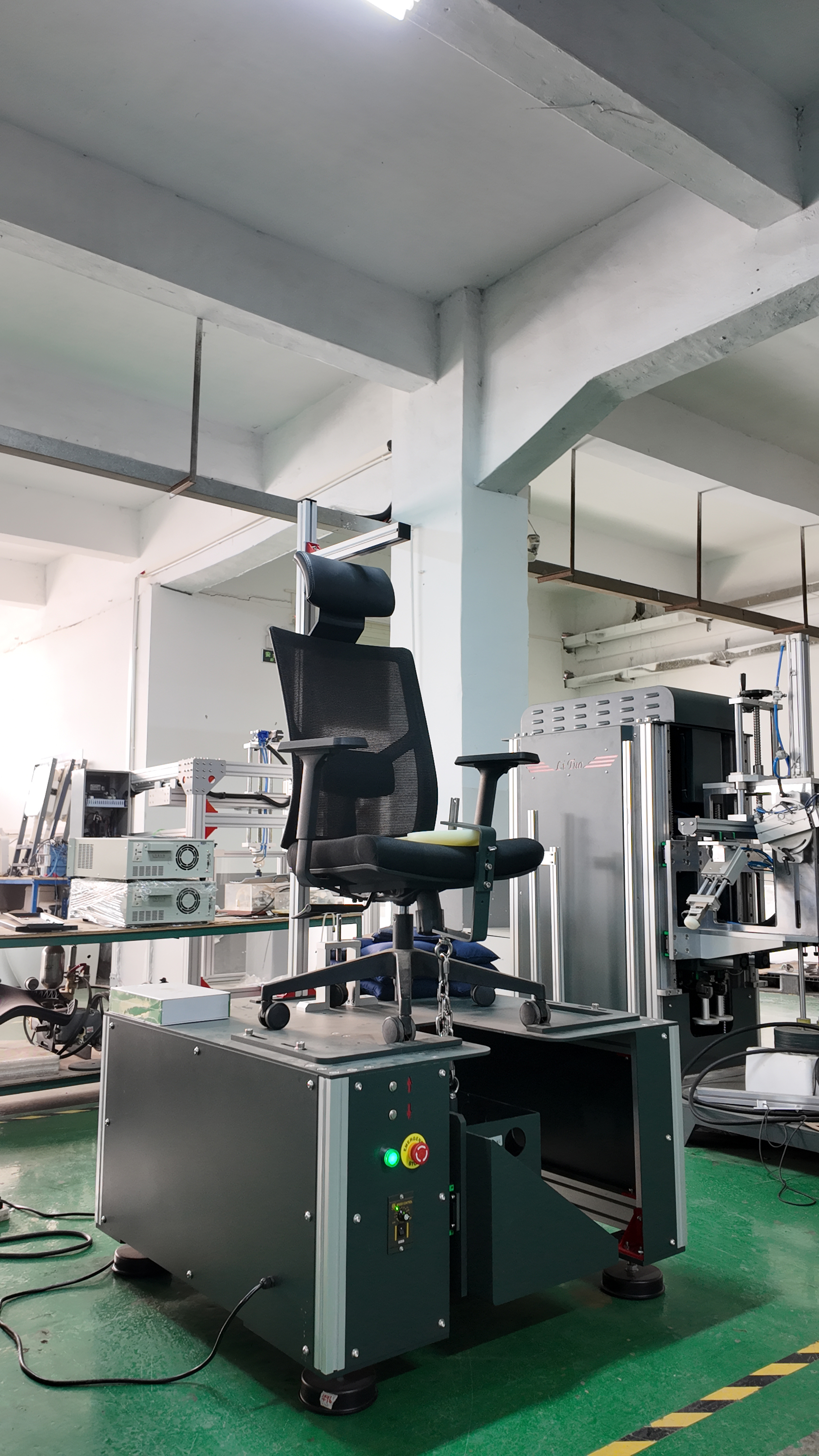
What is a Rear-Leaning Durability Testing Machine?
A Rear-leaning Durability Testing Machine for Office Chair Chassis is a programmable, robotic testing system engineered to evaluate the fatigue life and long-term performance of the tilt mechanism embedded within an office chair’s base (chassis). As your product description specifies, it is suitable for all chairs with a rear-tilt function. Its primary operation involves mounting the isolated chair chassis, applying a standardized load to simulate a seated user, and then repeatedly actuating the tilt mechanism through its full range of motion. By accelerating this cycle to hundreds or thousands per day, it compresses a decade of use into a short test period, providing quantifiable evidence of office chair chassis durability for mechanisms like synchro-tilt, knee-tilt, and multi-function locks.
Core Testing Principle: Simulating a Lifetime of Leans
The test replicates real-world physics with laboratory precision:
- Chassis Fixturing: The chair chassis is securely bolted to a rigid test platform, isolating it from the seat and backrest to focus stress solely on the mechanism.
- Applied Load Simulation: A calibrated weight or pneumatic cylinder applies a constant downward force (e.g., 110kg/242lbs as per BIFMA standards) onto the chassis’s pivot point, simulating a seated user’s weight.
- Programmed Motion Cycle: A robotic actuator engages the tilt control (lever or tension knob) and drives the chassis through a complete recline-and-return cycle. The angle, speed, and force of the tilt are precisely controlled.
- Accelerated Cycling: This cycle repeats at a high frequency (e.g., 10-20 cycles per minute), running continuously to achieve a target of 100,000, 200,000, or more cycles, simulating years of use.
The Standardized Durability Testing Protocol
Executing a valid chair tilt mechanism fatigue test follows a strict, internationally recognized protocol:
- Mounting & Calibration: The chassis is installed per the test standard. The applied load and tilt angle range are calibrated and verified.
- Parameter Programming: The total cycle count (e.g., 200,000 for heavy-duty use), tilt speed, and dwell time at the fully reclined position are input into the machine’s controller.
- Automated High-Cycle Testing: The machine takes over, performing the repetitive tilt action 24/7. It monitors for critical failures like a sudden loss of resistance or actuator jamming.
- Periodic Inspection & Maintenance: At specified intervals (e.g., every 50,000 cycles), testing pauses. The mechanism is inspected for wear, noise, and smoothness, and lubricated if required by the design, just as recommended in a user manual.
- Post-Test Evaluation & Failure Analysis: After completing the target cycles, the chassis undergoes a thorough functional check and tear-down inspection for broken springs, worn gears, cracked housings, or permanent deformation.
Why This Test is Critical for Chair Manufacturers
For any serious office furniture manufacturer, this test is a non-negotiable pillar of product integrity and business sustainability:
- Prevent Safety Failures & Liability: A catastrophic mechanism failure can cause a user to fall. This test identifies weak components before production, mitigating injury risks and massive recall costs.
- Ensure Compliance with Core Standards: Passing a rigorous BIFMA tilt test (e.g., BIFMA X5.1/X6.1) is a fundamental requirement for selling to corporate, government, and institutional clients.
- Control Warranty Costs & Build Trust: Catching a flawed gear design in the lab costs pennies compared to field replacements. Proven durability reduces warranty claims and builds long-term brand loyalty.
- Drive Design Innovation & Optimization: The test provides engineers with hard data to compare different spring systems, polymer vs. metal gears, and bearing designs, leading to more robust and cost-effective products.
Key Features of a Reliable Testing Machine
Selecting the right Rear-leaning Durability Testing Machine requires evaluation of these essential capabilities:
- Adjustable Load Capacity & Precision: Must apply and maintain accurate loads across the full spectrum of user weights defined by testing standards.
- Precise Angular Control & Measurement: The system must control the tilt angle with high repeatability and measure any permanent angle change (sag) after testing.
- High Cycle Rate & System Durability: The tester itself must be built to perform millions of cycles without downtime or loss of calibration.
- Universal & Secure Fixturing: Adaptable mounting plates and clamps are needed to securely hold various chassis shapes and sizes from different manufacturers.
- Comprehensive Data Logging: The ability to record cycle count, actuation force over time, and detect abnormal events is crucial for failure analysis and reporting.
Conclusion: Engineering Confidence into Every Recline
The true comfort of an office chair lies in the user’s subconscious trust that its movement will always be supportive and secure. The Rear-leaning Durability Testing Machine for Office Chair Chassis is the engineering instrument that builds this trust directly into the product’s core. By subjecting the tilt mechanism to an accelerated lifetime of validated stress, it transforms durability from a hopeful claim into an empirical, certifiable fact. Investing in this level of validation is not merely about passing a test; it is a foundational commitment to safety, quality, and the long-term satisfaction that turns first-time buyers into lifelong brand advocates.
Post time: Dec-24-2025


