



A Spray Force Tester is a specialized instrument designed to measure the spray impact force of showerheads and other spray products under controlled conditions. This testing is essential for verifying product performance, consumer satisfaction, and compliance with standards such as WaterSense, ASME, and EN. The device replicates real-world spray conditions to quantify how forcefully water jets hit a target surface.
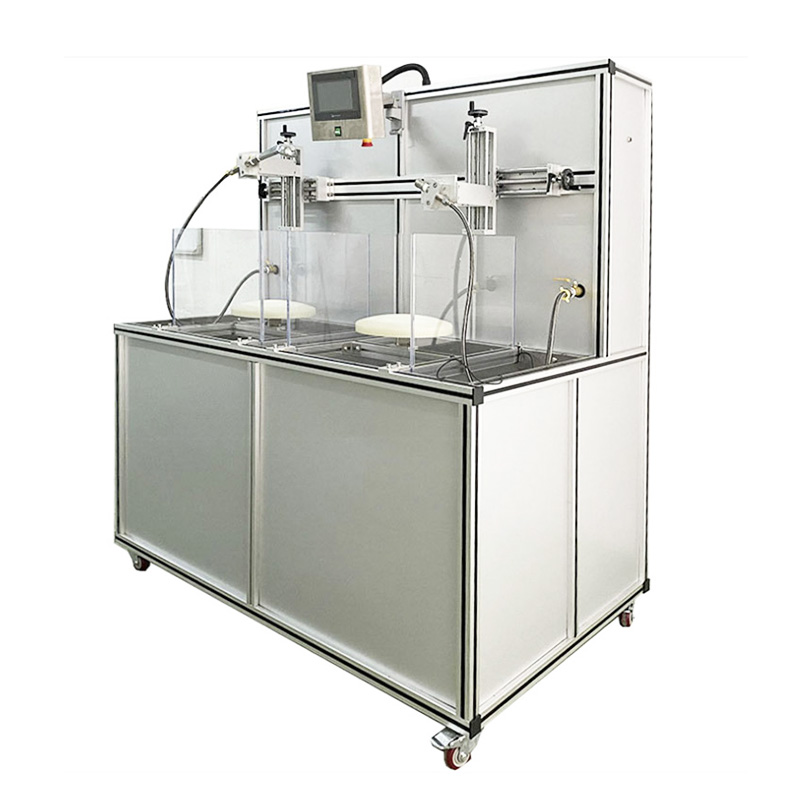
Key Features & Specifications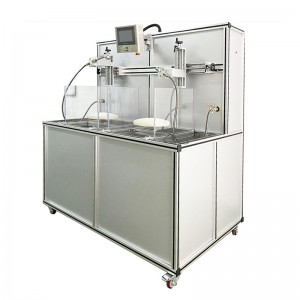
-
Working Voltage & Power: Three-phase 380 V, 3 kW
-
Control: Touch screen + PLC for real-time monitoring of force, time, and test parameters
-
Test Medium: Ambient-temperature water
-
Stations: 2 spray stations to facilitate comparative testing
-
Pressure Range: 0.05 – 1.0 MPa
-
Sensor: 0–100 N range, ±1% accuracy
-
Structure: Aluminum profile frame with aluminum-plastic sealing panels
-
Approximate Size: 1400 × 1200 × 1800 mm
These parameters ensure the Spray Force Tester can evaluate a wide range of shower products with high accuracy and repeatability.
How It Works
-
Sample Mounting & Alignment
The shower head is mounted at a fixed distance from a force plate or sensor. Alignment ensures that the axis of water spray is perpendicular or at a known angle to the force sensor. -
Pressure Control & Flow Initiation
The water pump is set to the desired static pressure within 0.05 to 1.0 MPa. After stabilization, spray begins toward the sensor or force plate. -
Force Measurement & Data Logging
The force sensor captures the impact force, which is displayed in real time. PLC or computer records time, pressure, force curves, and cycles. -
Repeat Tests & Stability Checks
Multiple cycles or sustained spray durations test stability. Variations over time highlight degradation or inconsistencies under prolonged use.
Why Spray Force Testing Matters
-
Consumer Experience: Spray force affects how “powerful” a shower feels. WaterSense demands a minimum spray force threshold (2 ozf or ~0.56 N) to ensure user satisfaction. 环境保护局+1
-
Performance Verification: Validates that design meets advertised performance across pressures and usage conditions.
-
Standards Compliance: Supports certification in programs like WaterSense that require validated spray force data.
Use Cases & Applications
-
Showerhead manufacturers use the tester during R&D to benchmark new designs.
-
Quality assurance labs validate production units for consistency.
-
Certification bodies require independent spray force data to issue WaterSense or equivalent labels.
-
Comparative testing — dual stations allow direct comparison of competing models.
Limitations & Considerations
-
The Spray Force Tester assumes laminar spray hitting a flat sensor; complex spray geometries (wide-angle, multi-jet) may require special fixtures or corrections.
-
Water temperature, nozzle wear, or flow inconsistencies can introduce error unless controlled carefully.
-
Some standards (especially rain shower types) modify spray force protocols (e.g. adjust for angle) to reflect vertical mounting.
Conclusion
A Spray Force Tester is indispensable for any organization seeking to validate the performance, consistency, and compliance of shower spray products. With precise instrumentation and methodical testing protocols, it bridges engineering design and user experience. By integrating spray force testing into the development and QA process, manufacturers can deliver better, more reliable products while gaining assurance from certification programs.
Post time: Oct-14-2025


