


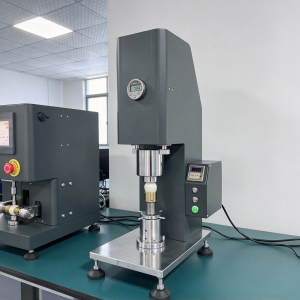
A Table Tennis Ball Hardness Testing Machine is designed to evaluate the hardness, deformation and consistency of table tennis balls through controlled compression testing. Hardness is an important quality characteristic because differences in ball deformation can affect the playing response, rebound behavior and overall consistency of a table tennis ball.
For manufacturers and testing laboratories, a repeatable table tennis ball hardness test provides useful data for product development, production inspection and quality control.
What Is a Table Tennis Ball Hardness Testing Machine?
A Ping Pong Ball Hardness Tester applies a specified load to a table tennis ball and measures its deformation using a precision measurement device.
The equipment uses a spherical ball seat to position the test specimen. During testing, the measuring gauge is brought into contact with the ball and manually zeroed. A fixed load of 50N ±0.5N is then applied and maintained for 15 seconds.
After the specified loading period, the deformation reading is recorded. The ball is then rotated 180° and tested again using the same procedure. The difference between the two measurements can be used to evaluate the consistency of the ball’s hardness and deformation characteristics.
How Does the Test Work?
The testing procedure is relatively straightforward:
- Place the table tennis ball securely on the test ball seat.
- Bring the measurement device into contact with the ball.
- Manually zero the measurement gauge.
- Apply a 50N ±0.5N load.
- Maintain the load for 15 seconds.
- Record the deformation reading.
- Return the loading mechanism to its original position.
- Rotate the ball 180°.
- Repeat the same test.
- Compare the two measurement results.
This method provides a simple way to identify differences in deformation between two positions of the same ball.
Precision Ball Positioning
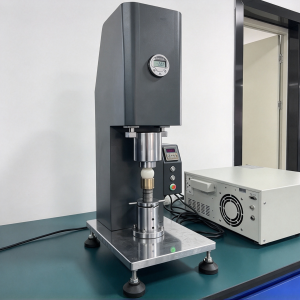
The testing machine uses a φ30 ±0.5mm copper spherical ball seat to provide stable support for the table tennis ball.
Accurate positioning is important because inconsistent placement can influence the measured deformation. The dedicated ball seat helps maintain a repeatable test position and provides a suitable contact condition during loading.
The measurement precision is 0.01mm, allowing small differences in deformation to be observed during testing.
Why Test Table Tennis Ball Hardness?
A table tennis ball needs consistent mechanical properties to provide predictable performance during play. Manufacturing variations or differences in material distribution can result in different deformation characteristics at different positions of the ball.
A controlled table tennis ball hardness test can help manufacturers evaluate:
- Ball deformation
- Hardness consistency
- Manufacturing consistency
- Structural uniformity
- Product quality
- Differences between production batches
Comparing measurements after rotating the ball 180° provides an additional indication of the consistency of the test specimen.
Standardized Loading Conditions
The use of a controlled 50N ±0.5N loading force helps establish a consistent testing condition.
The 15-second loading period provides a defined measurement point, while the precision gauge records the resulting deformation. By maintaining the same load and test duration for different samples, manufacturers can compare test results more effectively.
The equipment is designed to meet relevant requirements specified in GB/T 20045-2005, according to the provided product specification.
Applications
The Table Tennis Ball Hardness Testing Machine can be used by:
- Table tennis ball manufacturers
- Sports equipment manufacturers
- Table tennis product suppliers
- Sports equipment testing laboratories
- Quality inspection institutions
- R&D departments
- Universities and research laboratories
It can be used for incoming material inspection, production quality control, product development and comparative testing.
Key Technical Specifications
| Parameter | Specification |
|---|---|
| Test Function | Table tennis ball hardness and deformation testing |
| Loading Force | 50N ±0.5N |
| Loading Time | 15 seconds |
| Ball Seat | φ30 ±0.5mm copper spherical ball seat |
| Measurement Device | Dial gauge |
| Measurement Precision | 0.01mm |
| Test Method | Two measurements after 180° rotation |
| Applicable Standard | GB/T 20045-2005 |
Conclusion
A Table Tennis Ball Hardness Testing Machine provides a practical method for evaluating the deformation and hardness consistency of table tennis balls. By applying a controlled 50N load for 15 seconds and comparing measurements before and after a 180° rotation, manufacturers can obtain useful information about the mechanical consistency of their products.
With its dedicated copper spherical ball seat and 0.01mm measurement precision, the equipment is suitable for routine quality control, product development and laboratory testing of table tennis balls.
Post time: Sep-28-2026


