


For shower head manufacturers, factory testing is more than simply checking whether a product can deliver water normally. It is a systematic evaluation of functional reliability, connection strength, sealing performance, durability, and resistance to temperature and pressure changes.
During actual use, a shower head may undergo repeated function switching, directional adjustment, hot and cold water cycling, and continuous water pressure. Without sufficient testing before shipment, potential problems may only appear after the product has reached the end user.
A professional Shower Head Comprehensive Durability Testing Machine can simulate these conditions and help manufacturers identify potential quality issues before products leave the factory.
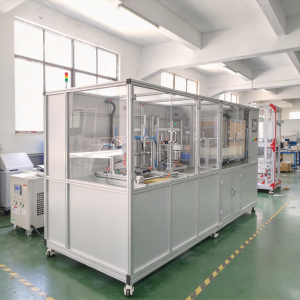
1. Function Switching Durability: Preventing Switching Failure
Many modern shower heads provide multiple spray modes. Users may repeatedly rotate or switch between these modes during daily use.
Therefore, function switching durability is an important factory test.
The testing machine repeatedly switches the shower head between different functions to evaluate whether the mechanism remains reliable after continuous operation.
Key problems that can be identified include:
- Switching becomes difficult
- Mechanism becomes stuck
- Spray mode cannot be changed
- Abnormal water flow
- Internal component damage
Repeated-cycle testing provides manufacturers with objective data for evaluating product durability and batch consistency.
2. Spherical Connection Swing Test: Evaluating Joint Durability
A handheld shower head is frequently adjusted to different spraying directions. As a result, its spherical connection can experience repeated movement during normal use.
The testing machine uses a pneumatic mechanism to perform repeated spherical connection swing testing, simulating long-term adjustment of the shower head.
This test helps evaluate whether the connection develops:
- Excessive looseness
- Abnormal wear
- Structural deformation
- Connection failure
It is particularly useful for identifying weaknesses in the mechanical design or assembly process.
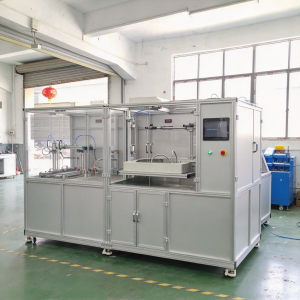
3. Hot and Cold Water Cycling: Testing Temperature Resistance
Shower heads do not normally operate at a constant water temperature. During everyday use, they may repeatedly experience cold, warm, and hot water.
These temperature changes can affect plastic components, metal parts, seals, and internal connections.
Therefore, hot and cold water cycling is an important method for evaluating long-term reliability.
The testing system can provide a water temperature range of approximately:
5–90°C
The thermal cycling pressure range can reach:
0.05–1.8 MPa
By repeatedly exposing the product to different temperature and pressure conditions, manufacturers can simulate the thermal stress experienced during actual use.
After testing, the shower head can be inspected for:
- Water leakage
- Seal failure
- Component deformation
- Loose connections
- Functional abnormalities
4. Sealing Test: Preventing Leakage Problems
For shower heads, sealing performance is directly related to product quality and user experience.
A product may look perfect externally while still having problems with internal sealing components. Under water pressure, these problems can result in leakage or dripping.
The testing machine can perform pressure-based sealing tests under controlled conditions.
Typical static water pressure can be adjusted within:
0.05–0.8 MPa
This allows manufacturers to evaluate whether the shower head maintains proper sealing under specified pressure conditions.
Reliable sealing testing can help reduce customer complaints and after-sales service caused by leakage.
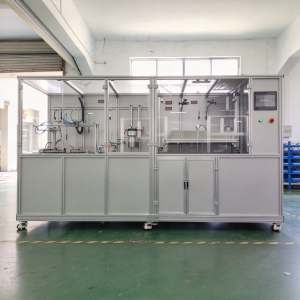
5. Clearance Impact Test: Identifying Structural Weaknesses
Certain shower head components may experience repeated mechanical impact during installation, adjustment, or long-term use.
The clearance impact test is designed to simulate these conditions and evaluate the durability of structural components.
It can help identify:
- Loose moving components
- Excessive mechanical clearance
- Damaged connection parts
- Functional problems after repeated impact
This type of testing can reveal structural weaknesses that may not be detected through simple visual inspection.
6. Different Tests Require Different Key Parameters
A comprehensive shower head test should not rely on a single performance indicator. Different tests focus on different aspects of product reliability.
| Test Item | Main Purpose | Key Parameters |
|---|---|---|
| Function Switching Durability | Evaluate switching mechanism life | Cycle count |
| Spherical Connection Swing | Evaluate joint durability | Swing cycles, pneumatic drive |
| Hot & Cold Water Cycling | Evaluate temperature resistance | 5–90°C |
| Water Pressure Test | Evaluate pressure resistance and sealing | 0.05–0.8 MPa |
| Thermal Cycling Pressure | Evaluate durability under thermal and pressure changes | 0.05–1.8 MPa |
| Clearance Impact | Evaluate structural durability | Impact cycles |
| Sealing Test | Verify leak resistance | Specified water pressure |
These different parameters allow manufacturers to evaluate shower heads from multiple perspectives, including function, mechanical durability, temperature resistance, water pressure, and sealing performance.
7. Four-Station Design for Efficient Factory Testing
For manufacturers that need to conduct multiple durability tests, an integrated testing machine can reduce repeated loading, unloading, and product transfer between different machines.
The Shower Head Comprehensive Durability Testing Machine can be configured with four test stations:
- Station 1: Spherical connection swing test
- Stations 2–3: Shower head function switching durability tests
- Station 4: Thermal fatigue, clearance impact, and sealing tests
The system uses PLC and touchscreen control, while pneumatic mechanisms perform the required movements.
The main technical specifications include:
- Hot and cold water temperature: 5–90°C
- Static water pressure: 0.05–0.8 MPa
- Thermal cycling pressure: 0.05–1.8 MPa
- Test stations: 4
- Maximum power: 15 kW
- Main machine dimensions: approximately 3200 × 1200 × 1800 mm
- Control system: PLC + Touchscreen
- Drive system: Pneumatic
The pump, heating, and refrigeration system uses three-phase AC380V power, while the control system uses single-phase AC220V.
8. From Factory Inspection to Quality Control
For shower head manufacturers, factory testing is not simply about determining whether a product passes or fails.
More importantly, continuous testing provides valuable data for quality control and process improvement.
For example, if different production batches show significant differences in function switching life, sealing performance, or hot and cold cycling resistance, manufacturers can investigate potential causes related to materials, molds, assembly processes, or component suppliers.
In this way, shower head durability testing can become an important part of a manufacturer’s overall quality management system.
Conclusion
Although a shower head appears to be a relatively simple sanitary product, it must withstand repeated operation, water pressure, temperature changes, and mechanical movement throughout its service life.
Therefore, comprehensive shower head factory testing should cover multiple performance areas, including function switching, spherical connection swing, hot and cold water cycling, clearance impact, and sealing performance.
By using different test parameters for different performance requirements, manufacturers can identify potential failures before shipment, improve product consistency, reduce after-sales risks, and provide more reliable quality assurance for customers.
Post time: Oct-09-2026


