


Introduction: The Critical Need for Toilet Seat and Cover Durability Testing
Toilet seats and covers are among the most frequently used components in any bathroom. They are opened and closed dozens of times daily, subjected to the weight of users, and expected to perform reliably for years. A seat that fails to stay open, closes too quickly, develops cracks, or loses its slow-close damping function leads to customer complaints, product returns, and brand damage. The Toilet Seat and Cover Durability Testing Machine is a specialized testing system designed to evaluate the open-close life, slow-close performance, and strength durability of toilet seats and covers. By simulating years of daily use in a controlled laboratory environment, this machine provides objective, repeatable data that helps manufacturers ensure product quality, verify hinge durability, and meet international standards.
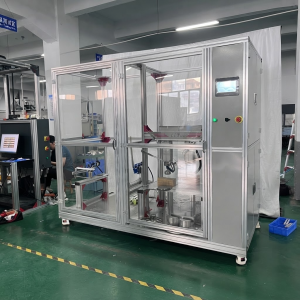
Advanced Control System: Precision and Automation
The Toilet Seat and Cover Durability Testing Machine is powered by a sophisticated control system consisting of a touch screen interface, PLC (Programmable Logic Controller), pneumatic cylinders or servo motors, force sensors, and professional test software. This integrated system delivers:
- Intuitive operation: The touch screen interface allows operators to easily set test parameters, monitor real-time data, and access test results.
- Precise control: PLC-based control ensures accurate and repeatable test sequences, eliminating human variability.
- Versatile actuation: Pneumatic cylinders provide smooth, controlled motion for standard open-close tests, while servo motors offer precise position and speed control for more demanding applications.
- Real-time force monitoring: High-precision force sensors continuously measure operating torque and applied loads, providing comprehensive performance data.
- Automated data management: The professional test software records all test parameters, sensor data, and cycle counts, generating detailed reports for quality documentation.
How the Toilet Seat and Cover Durability Testing Machine Works
The Toilet Seat and Cover Durability Testing Machine operates on a robust electromechanical principle. The machine features a precision actuation system that repeatedly raises and lowers the toilet seat or cover through its full range of motion. The test sequence simulates the three critical aspects of real-world usage:
- Normal opening and closing – Simulating daily use by lifting and lowering the seat/cover at a controlled speed
- Slow-close (damping) function testing – Verifying that the slow-close mechanism maintains its damping performance over thousands of cycles
- Strength/pressure testing – Applying controlled force to simulate the weight of a user sitting or leaning on the seat/cover
The machine uses high-precision sensors to monitor operating torque, closing speed, and structural integrity throughout the test, providing comprehensive data on performance degradation over the product’s service life.
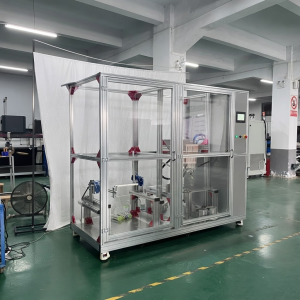
Comprehensive Testing Capabilities
The Toilet Seat and Cover Durability Testing Machine performs three primary tests to fully characterize seat and cover performance.
1. Open-Close Life Cycle Test (Durability)
The core test for evaluating the service life of toilet seats and covers. The machine repeatedly opens and closes the seat and cover for a preset number of cycles (typically 50,000 to 200,000 cycles). During the test, the machine monitors:
- Operating torque: The force required to open and close the seat, detecting any increase that indicates hinge wear or contamination
- Closing speed consistency: Ensuring that the slow-close mechanism maintains consistent damping performance
- Structural integrity: Detecting any cracking, loosening, or deformation of the seat, cover, or hinge assembly
2. Slow-Close (Damping) Function Test
This test specifically evaluates the performance of the slow-close mechanism, a key selling point for modern toilet seats. The machine measures:
- Closing time: The duration from release to fully closed position (typically 3–8 seconds for standard slow-close seats)
- Damping consistency: Whether the closing speed remains uniform throughout the range of motion
- Damping degradation: Performance decline after repeated cycles, indicating wear of the hydraulic or mechanical damping elements
The test can be conducted under both normal and accelerated conditions to assess long-term damping reliability.
3. Strength and Overload Test (Pressure Test)
This test simulates the weight of a user sitting or leaning on the seat or cover. The machine applies a controlled static or dynamic load to the seat/cover surface, evaluating:
- Static load capacity: Maximum weight the seat can support without permanent deformation or damage
- Impact resistance: Ability to withstand sudden loads (simulating a person sitting down heavily)
- Hinge strength: Resistance of the hinge mechanism to lateral and vertical forces
Key Technical Specifications
Professional Toilet Seat and Cover Durability Testing Machines feature the following specifications:
- Test Stations: Single or dual stations for simultaneous testing
- Operation Cycle: 1–30 cycles per minute (adjustable)
- Open Angle: 0°–180° (adjustable)
- Load Capacity: Up to 200 kg for strength tests
- Load Cell Accuracy: ±0.5% of reading
- Control System: Touch screen + PLC + pneumatic cylinder/servo motor + force sensor + professional test software
- Test Cycles: Programmable up to 999,999 cycles with automatic stop
- Data Output: Torque curve, closing time, cycle count, force data
- Power Supply: 220V AC, 50/60Hz
- Fixture Adjustability: Adjustable to accommodate different seat sizes and hinge types
Compliance with International Standards
The Toilet Seat and Cover Durability Testing Machine is designed to meet the requirements of major international sanitary ware standards:
- EN 12540: Sanitary appliances – Toilet seats and covers – Performance and test methods
- ASME A112.19.2: Ceramic plumbing fixtures – Toilet seats and covers performance requirements
- GB/T 2317: Chinese national standard for toilet seat and cover tests
- ISO 8302: Sanitary appliances – Toilet seats and covers – Determination of durability
Applications and Industries
The Toilet Seat and Cover Durability Testing Machine is widely used across multiple sectors for quality control, material development, and product certification:
- Toilet and Sanitary Ware Manufacturers: Validate new seat designs and ensure batch-to-batch quality consistency
- Hinge and Damping Mechanism Suppliers: Certify components for OEM customers
- Testing Laboratories: Conduct third-party compliance testing per EN, ASME, GB, and ISO standards
- R&D Departments: Compare different hinge materials, damping technologies, and seat constructions
- Quality Control Departments: Perform routine production testing to identify defects before shipment
Key Benefits for Manufacturers and Testing Laboratories
- Comprehensive Testing: One machine performs open-close life, slow-close damping, and strength tests
- Standard Compliance: Meets EN 12540, ASME A112.19.2, GB/T 2317, and ISO 8302 requirements
- Automated Operation: PLC + touch screen control with programmable test cycles and automatic stop
- Precision Measurement: High-accuracy force sensors ensure reliable, repeatable results
- Versatility: Adjustable fixtures accommodate different seat sizes, hinge types, and mounting configurations
- Data-Driven Quality: Comprehensive data on torque, closing time, and strength enables continuous product improvement
- Reduced Warranty Claims: Identify weak points in hinge design, damping mechanisms, and seat materials before products reach the market
Testing Procedure Overview
A typical test using the Toilet Seat and Cover Durability Testing Machine follows this workflow:
- Specimen Mounting: Install the toilet seat and cover onto the test fixture, replicating actual installation conditions
- Parameter Setting: Program open angle, closing speed, test frequency, load (for strength test), and target cycle count via the touch screen interface
- Initial Measurement: Record baseline closing time and operating torque using the force sensor
- Test Execution: Start the test; the PLC-controlled system automatically performs repeated open-close cycles while monitoring torque and closing time
- Periodic Checks: The system records performance data at regular intervals to track degradation trends
- Final Evaluation: After completing the target cycle count, inspect the seat, cover, and hinge for wear, cracking, or functional degradation
- Report Generation: The professional test software produces a comprehensive test report documenting test parameters, performance data, and pass/fail determination
Conclusion: The Essential Tool for Toilet Seat and Cover Quality Assurance
The Toilet Seat and Cover Durability Testing Machine is an indispensable instrument for any manufacturer, testing laboratory, or quality control department involved in sanitary ware production. By accurately simulating the open-close cycles, slow-close damping performance, and strength demands that toilet seats and covers endure during their service life, this machine provides objective, repeatable data that helps manufacturers ensure product quality, meet international standards, and build customer confidence. With its advanced PLC + touch screen control system, precision force sensors, and professional test software, the tester delivers the insights needed to build seats and covers that are durable, reliable, and safe for everyday use.
Post time: Aug-24-2026


