


Toilet seats and covers are frequently used bathroom components. Every opening, closing, sitting, lifting, and lowering operation places mechanical stress on the seat, cover, hinges, and soft-closing mechanism. Over time, repeated use can cause loosening, deformation, cracking, hinge failure, or loss of soft-closing performance.
For manufacturers, simply checking the appearance or basic function of a toilet seat is not enough. Toilet Seat Testing should also evaluate durability, strength, load-bearing capacity, and functional performance under repeated use.
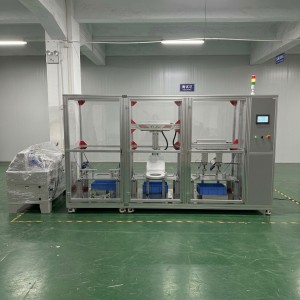
The Toilet Seat and Cover Comprehensive Performance Testing Machine is designed to perform multiple tests on toilet seats and covers, including opening and closing, swing, high-pressure, static load, and soft-closing durability testing.
What Is Toilet Seat and Cover Performance Testing?
Toilet seat and cover performance testing is used to evaluate whether a finished toilet seat can maintain its required functionality and structural integrity under simulated use conditions.
Depending on the test requirement, the product may be subjected to:
- Repeated opening and closing
- Repeated swinging
- Static loading
- High-pressure loading
- Soft-closing cycles
- Long-term repeated operation
The purpose is to identify potential failures before the product enters mass production or the market.
A comprehensive Toilet Seat Tester combines several of these tests into one testing system, making it more efficient than using separate machines for every test.
Why Is Toilet Seat Durability Testing Important?
A toilet seat may appear perfectly functional when it is new. However, hinges and soft-closing mechanisms are mechanical components that experience repeated movement throughout the product’s service life.
After many cycles, manufacturers may encounter problems such as:
- Hinge loosening
- Seat deformation
- Cover cracking
- Soft-closing failure
- Abnormal noise
- Reduced opening and closing performance
- Structural damage
- Fastener failure
A Toilet Seat Durability Tester simulates repeated use so that these potential problems can be identified during product development and quality control.
What Tests Can Be Performed?
The Toilet Seat and Cover Comprehensive Performance Testing Machine integrates five major testing functions.
1. Opening and Closing Test
The machine repeatedly opens and closes the toilet seat and cover to simulate everyday operation.
This test evaluates the durability of hinges, mounting components, and other moving parts.
After the specified number of cycles, the product can be inspected for damage, loosening, deformation, or abnormal operation.
2. Swing Test
Swing testing evaluates the resistance of the toilet seat assembly to repeated lateral or swinging forces.
The equipment provides a swing-cylinder force range of 0–2000 N with Class 0.5 accuracy, allowing controlled loading during the test.
This test is particularly useful for evaluating the strength of the hinge and connection structure.
3. Static Load Test
A toilet seat must be able to withstand the load applied during normal use.
The static load test evaluates the structural strength of the seat and its mounting system under a specified load.
It can help identify:
- Seat deformation
- Hinge damage
- Mounting failure
- Structural cracking
- Excessive displacement
4. High-Pressure Test
The high-pressure test applies a rapid force to the specified area of the toilet seat or cover.
The equipment is designed for a high-pressure test speed of less than one second, providing a rapid loading process for evaluating structural resistance.
5. Soft-Closing Durability Test
Soft-closing toilet seats are increasingly popular because they reduce noise and improve user experience.
However, the soft-close mechanism must maintain its function after repeated operation.
A Soft Close Toilet Seat Tester can simulate repeated opening and controlled closing to evaluate whether the damping mechanism continues to operate properly after extended use.
Three-Station Testing Design
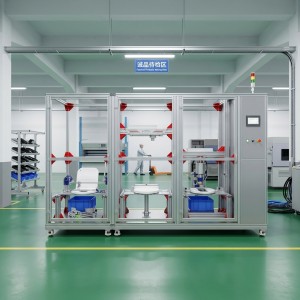
One of the key features of this equipment is its three-station configuration.
The three stations are arranged as follows:
- Station 1: Opening/closing, soft-closing, and high-pressure testing
- Station 2: Swing testing
- Station 3: Static load testing
This configuration allows different performance tests to be organized within one integrated machine.
For sanitary ware manufacturers and testing laboratories, a multi-station design can improve testing efficiency while reducing the need for multiple individual testing systems.
High-Capacity Cycle Testing
Durability testing often requires a large number of repeated cycles.
The equipment provides a cycle counter ranging from 0 to 990,000 cycles, with a counting accuracy of ±1 cycle.
This makes it suitable for long-term durability evaluation of toilet seat hinges, covers, and soft-closing mechanisms.
Accurate cycle counting is important because the final test result must be associated with a clearly defined number of operating cycles.
Precise Force Control
Mechanical strength testing requires controlled and repeatable loading.
The swing cylinder provides a force range of 0–2000 N with Class 0.5 accuracy.
Precise force control helps ensure that different samples can be tested under consistent conditions, making test results more useful for product comparison and quality control.
Compact and Practical Machine Design
Laboratory space is an important consideration when selecting testing equipment.
The machine uses a compact integrated design with a rational layout. It is equipped with casters for movement and adjustable leveling for installation.
The equipment has a floor clearance of 150 mm, which provides practical space beneath the machine and facilitates laboratory installation.
The overall design is intended to make operation straightforward without requiring frequent disassembly of the test specimen or equipment.
Applicable Standards
The Toilet Seat and Cover Comprehensive Performance Testing Machine is designed according to the requirements specified by relevant sanitary ware standards, including:
- JC/T 764-2024
- 5.4.5 and 6.10 — Opening and Closing Test
- 6.7 — Swing Test
- 5.4.6 and 6.11 — Soft-Closing Function Life Test
- 6.13 — Static Load Test
- GB 34549-2024
- Opening and Closing Test
When conducting formal laboratory testing, the exact test parameters and procedures should be configured according to the applicable clauses and the specific product being evaluated.
Who Needs a Toilet Seat Testing Machine?
A professional Toilet Seat Testing Machine can be used by:
- Toilet Manufacturers
- Sanitary Ware Manufacturers
- Toilet Seat Manufacturers
- Toilet Cover Manufacturers
- Bathroom Hardware Manufacturers
- Soft-Closing Hinge Manufacturers
- Sanitary Ware Laboratories
- Quality Inspection Laboratories
- Testing and Certification Organizations
- Product R&D Centers
- Universities and Research Institutes
It can support new product development, production quality control, supplier evaluation, product comparison, and durability verification.
Benefits of Comprehensive Toilet Seat Testing
Using one integrated Toilet Seat and Cover Testing Machine provides several advantages.
Improved Testing Efficiency
Multiple tests can be performed using one integrated system instead of requiring separate equipment for each test.
Better Product Development
Engineers can identify weak points in hinges, mounting structures, covers, and soft-closing mechanisms during the development stage.
More Consistent Test Conditions
Automated mechanical movement and controlled loading help reduce variations caused by manual operation.
Better Durability Evaluation
High-cycle testing can reveal failures that may not be visible during short-term functional inspections.
Support for Standards-Based Testing
The machine can be configured according to applicable test requirements for opening and closing, swing, static load, and soft-closing durability.
Conclusion
A toilet seat is a frequently operated mechanical product, and its long-term performance depends heavily on the durability of its hinges, mounting system, cover, and soft-closing mechanism.
The Toilet Seat and Cover Comprehensive Performance Testing Machine combines opening and closing, swing, high-pressure, static load, and soft-closing durability tests into a three-station testing system. With high-cycle counting, precise force control, adjustable leveling, and a compact structure, it provides a practical solution for comprehensive toilet seat performance evaluation.
For sanitary ware manufacturers, incorporating Toilet Seat Durability Testing into product development and quality control can help identify potential failures earlier, improve product reliability, and provide stronger support for standards-based product testing.
Post time: Sep-10-2026


