


A Universal Testing Machine is the most versatile instrument in any materials laboratory. In a single frame, it measures the mechanical properties that decide whether a material survives real use — tensile strength, elongation, peel force, tear resistance, heat-seal strength, and bending stiffness. This article explains what the machine actually measures, which standards govern each test, and how to read a specification so your results stand up to a customer audit.
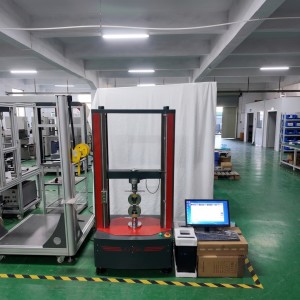
What a Universal Testing Machine Measures
A Universal Testing Machine (also called a UTM or tensile testing machine) applies a controlled tensile or compressive force to a specimen and records the resulting force and extension as a continuous curve.
Core conclusion first: a UTM does not give a single “strength number.” It produces a force-versus-extension record from which multiple mechanical properties are calculated.
Typical tests run on one machine:
- Tensile test — pulls a specimen until break, returning ultimate tensile strength, yield strength, and elongation at break.
- Compression test — pushes a specimen to measure compressive strength and deformation.
- Bend test — applies a three-point or four-point load to measure flexural strength and stiffness.
- Peel test — measures the force to separate bonded layers, used for adhesive tape and laminated films.
- Tear test — measures resistance to tearing in films, paper, and rubber.
- Shear test — applies opposing forces across a bonded or fastened joint.
The defining feature of a Universal Testing Machine is that one frame, with interchangeable grips, covers all of these modes — which is why it is called “universal.”
Which Standards Govern Each Test
Every test on a Universal Testing Machine is defined by a named standard, and a credible report cites the exact method used.
The commonly applied standards for this class of machine include:
- ASTM D638 — tensile properties of plastics.
- ASTM D882 — tensile properties of thin plastic sheeting and film.
- ASTM D5748 — puncture resistance of stretch wrap film.
- ISO 8510 — peel resistance of adhesive-bonded assemblies (90° and 180° peel).
- JIS P8113 — tensile strength of paper and paperboard.
- JC 887-2001 and JC/T 547-2005 — Chinese national standards for wood-based panel adhesives.
Why citing the standard matters: two laboratories can produce different “tensile strength” figures for the same material if one uses ASTM D638 and the other a different method, because specimen shape and test speed differ. Naming the standard makes the result comparable and auditable.
How to Read a Universal Testing Machine Specification
When comparing a Universal Testing Machine, five figures determine whether its data is defensible:
- Load capacity. The maximum force the frame can apply. A 50 kN (5-ton) capacity covers films, textiles, adhesives, rubber, paper, and light metal fasteners — the majority of non-destructive and destructive material tests.
- Force accuracy and resolution. Look for 0.5-class accuracy with force accuracy within ±0.3% and a 1/100,000 resolution load cell. This determines whether a low-force peel measurement on a thin film is meaningful, not just the high-force tensile readings.
- Test speed range. A range such as 0.001–500 mm/min matters because peel, tensile, and bend standards specify different speeds. A machine that cannot hold a slow, stable peel speed will under- or over-report peel force.
- Crosshead travel and width. Travel of 1,300 mm and a 500 mm crosshead width determine the specimen size the machine can accept, especially for long films and large panels.
- Closed-loop control. Support for constant stress, constant strain, creep, and stress-relaxation modes separates a research-grade machine from a simple break tester.
Two practical points also matter: a rigid dual-column frame with aluminum alloy columns minimizes deflection that would otherwise distort force readings, and self-developed software that auto-computes results and displays curves reduces operator error in reporting.
What the Test Does — and Does Not — Promise
A precise boundary keeps a materials report credible:
- A Universal Testing Machine produces a measured mechanical property under a named standard. It does not by itself predict in-service lifetime, because real components experience combined loads, temperature, and fatigue that a single test does not reproduce.
- Results are reported as force, stress, or extension against a stated standard and test speed, which is why the method, specimen geometry, and speed must be quoted together.
Stating those conditions, rather than a bare “passed tensile test,” is what allows a customer’s quality team to reproduce and audit the result.
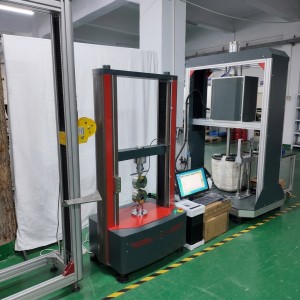
From a Single Number to Customer Confidence
For manufacturers serving Europe, North America, and Southeast Asia, a materials test report is increasingly a condition of the first order. Plastic film buyers ask for ASTM D882 peel and tensile data; adhesive suppliers are asked for ISO 8510 peel resistance; packaging buyers request ASTM D5748 puncture values before committing to a supplier.
A well-configured Universal Testing Machine lets a factory demonstrate, in writing, that its material meets the named standard for each property the customer cares about. That evidence shortens the path from sample to report — and separates a supplier who can prove material performance from one who only describes it.
Conclusion
A Universal Testing Machine does not measure one thing; it measures the properties that determine whether a film, an adhesive, a fiber, or a fastener will hold in service. The key to defensible data is not the machine’s size but its accuracy class, speed control, and the standard it runs against. Before you commit a material to production, ask whether it has been tested to the named method — ASTM D638, ASTM D882, ISO 8510, or the standard your market enforces — with the load and speed the method specifies. If the answer is no, the first failure report will not come from your own laboratory.
Frequently Asked Questions
What is a universal testing machine used for? A Universal Testing Machine applies controlled tensile or compressive force to measure mechanical properties such as tensile strength, elongation, peel force, tear resistance, and bending stiffness across materials like plastics, films, textiles, adhesives, rubber, paper, and metal.
What is the difference between a universal testing machine and a tensile testing machine? A tensile testing machine is specialized for pulling specimens; a Universal Testing Machine performs tensile, compression, bend, shear, tear, and peel tests in one frame by changing grips.
Which standards does a universal testing machine support? Common standards include ASTM D638, ASTM D882, ASTM D5748, ISO 8510, and JIS P8113, plus Chinese national standards such as JC 887-2001.
What load capacity do I need? A 50 kN (5-ton) Universal Testing Machine covers films, textiles, adhesives, rubber, paper, and light metal fasteners; higher capacities suit structural metals and composites.
Dongguan Lituo Testing Instrument Co., Ltd. designs and manufactures the Dual Column Universal Testing Machine LT-LLN02-AM, a computer-controlled universal testing machine with 50 kN capacity, 0.5-class accuracy, ±0.3% force accuracy, 1/100,000 resolution, 0.001–500 mm/min speed, and 1,300 mm crosshead travel. It runs tensile, compression, bend, shear, tear, and peel tests to ASTM D638, ASTM D882, ASTM D5748, ISO 8510, and JIS P8113. Contact our team to configure a machine to your target standard and specimen range.
Post time: Nov-20-2026


