



The modern logistics chain subjects packaged goods to a variety of dynamic forces—forklift collisions, sliding into racks, sudden stops, horizontal and inclined impacts. In order to ensure the durability and safety of packages, the Bevel Impact Test Table has emerged as an essential piece of testing equipment. This machine is specifically designed to replicate inclined-plane impacts (sometimes referred to as bevel or ramp impacts) in a controlled lab environment, enabling companies to validate packaging design, material strength, and compliance with industry standards.
What Is a Bevel Impact Test Table?
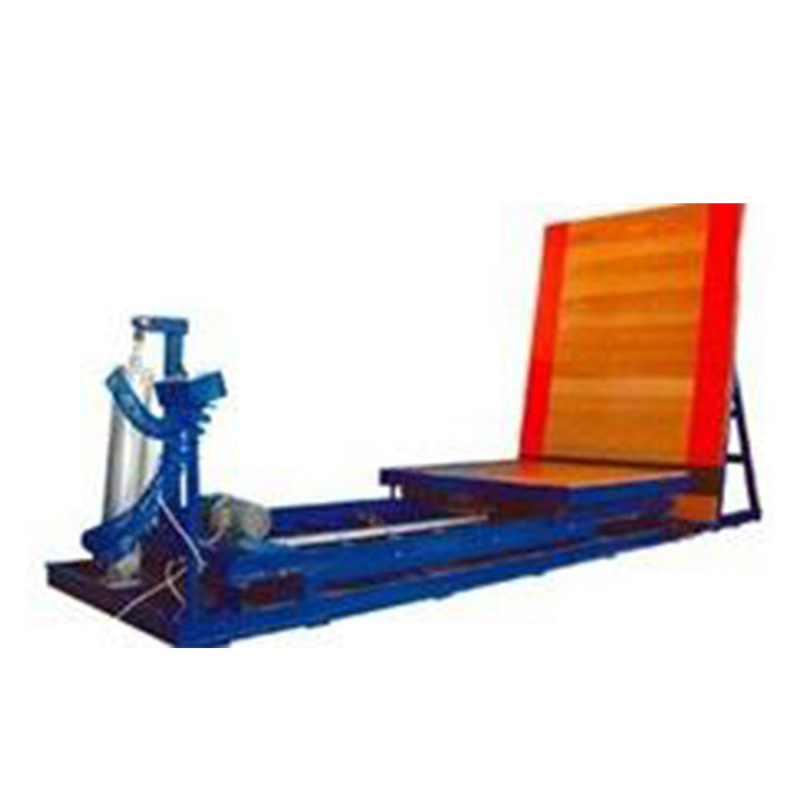
A Bevel Impact Test Table (also called an inclined impact tester) consists of a sliding trolley on an inclined ramp or track that propels the test specimen into a fixed impact plate at a predetermined speed. As the specimen transitions from potential to kinetic energy, it collides with the rigid barrier, creating a controlled impact event. According to suppliers, these machines simulate real-life handling conditions such as motor rack sliding, forklift tilting, and pallet-unit transport.
Key specifications may include carriage load capacities varying from 100 kg up to 600 kg (or more), sliding lengths of 1,600 mm to 4,000 mm, impact speeds of nearly 1.0-3.0 m/s with velocity error typically ±5%. The Bevel Impact Test Table thus serves as a critical tool for packaging performance validation and transport simulation.
Why Inclined/Bevel Impact Testing Matters for Packaging
During transit, packages may experience unexpected collisions not only from drops or vertical impacts, but from angled or horizontal crashes—such as a pallet sliding off a rack, or a unit shifting in a container. These events apply forces along an inclined vector rather than purely vertical, causing stress on corners, edges, and seams in packaging.
Standards like ISO 2244, GB/T 4857.11, ISTA’s inclined impact protocols, and ASTM D-880 describe testing methods for these impacts. A Bevel Impact Test Table replicates these conditions with high repeatability, enabling manufacturers to uncover weaknesses—such as poor corner reinforcement, low edge crush resistance, or unstable pallet loads—and thus improve protection and reduce damage rates.
How the Bevel Impact Test Table Works
Setup & Control
Mount the package or unit-load specimen on the carriage or sliding pallet of the impact table. The length of the slide, the incline angle (often around 10°), and the starting distance are configured according to the test protocol. A micro-processor or PLC control system adjusts speed and monitors collision parameters.
Impact Execution
The carriage slides down the ramp under gravity or assisted drive until it hits the rigid impact plate at a predefined velocity—typically 1.2–2.3 m/s with allowable deviation ±5%. he impact panel may measure 1,600 × 2,000 mm (or custom) and the specimen size may reach L 1,200 × W 1,200 × H 1,500 mm. After the collision, energy is absorbed by the package and any damage is assessed.
Evaluation & Reporting
Post-impact, the package is inspected for deformation, tearing, tearing of film, delamination, or breakage of contents. Data is collected on impact speed, load, sliding length, number of cycles, and the control system outputs pass/fail metrics. The Bevel Impact Test Table ensures high precision, minimal rebound effect, and consistent test conditions.
Key Technical Features to Look For
-
Load capacity choices: 100, 200, 300, 500, 600 kg (or more) to match test specimens.
-
Impact panel size: Typical 1,600 × 2,000 mm, customizable.
-
Maximum impact speed: Up to 2.3 m/s or more, with error ±5%.
-
Maximum sliding length: 1,600 mm or 2,000 mm (or agreement).
-
Specimen maximum size: L 1,200 × W 1,200 × H 1,500 mm.
-
Control system: Micro-processor based, often three-phase 380 V 50/60 Hz.
-
Working environment: 0–40 °C, humidity ≤80%.
These specifications ensure that the Bevel Impact Test Table can adapt across packaging types—from light cartons to heavy pallet loads—and produce reliable impact simulation data.
Benefits of Using a Bevel Impact Test Table
-
Proactive damage prevention: By simulating real transport shocks, manufacturers can identify weak packaging areas before shipment, reducing returns and damage.
-
Compliance & certification: Helps meet packaging test standards (ISTA, ISO, GB).
-
Enhanced product protection: Improves design of inner packaging, cushioning, pallet stabilization, and load-bearing corners.
-
Operational efficiency: Provides repeatable, controlled impact events with recorded data, minimizing human variation and increasing throughput.
Application Scenarios
-
Packaging material manufacturers testing corrugated board, foam inserts and pallet wrap behavior under inclined impacts.
-
Logistics operations simulating pallet sliding in racking systems or container shifts.
-
Export testing labs using the table to validate shipments for compliance with ISTA 3E/3J and Amazon-shipping protocols.
-
R&D departments for transport packaging design optimization—testing changes in rails, friction coefficients, and impact barriers.
Conclusion
The Bevel Impact Test Table is indispensable for any company focused on packaging reliability, transport safety, and damage reduction. With its ability to reproducibly simulate inclined-plane impact events, it enables designers and engineers to improve packaging systems, meet rigorous standards, and ensure goods reach their destination intact. Investing in such a system is not only a safeguard against supply-chain risk—but a tangible enhancement of product quality and customer trust.
Post time: Oct-22-2025


