


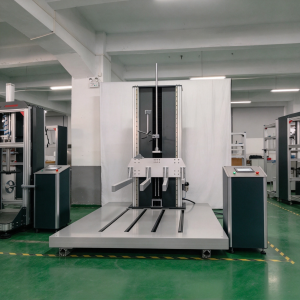
A Zero Height Drop Testing Machine is designed for evaluating the impact resistance of large and heavy packages during transportation, handling, loading and unloading. Unlike conventional drop testers that require the package to be lifted to a specified height, a zero-height drop system uses a rapidly retracting support platform to create a sudden free fall of the test package.
This testing method provides manufacturers with a practical way to evaluate packaging impact resistance, identify potential structural weaknesses and improve packaging design.
What Is a Zero Height Drop Testing Machine?
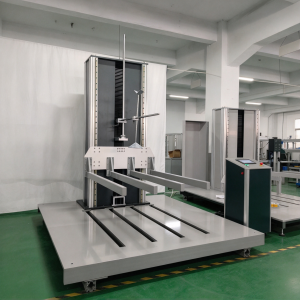
A Zero Height Drop Tester uses an E-shaped support fork to hold the test package. The package is positioned according to the required test orientation, including face, edge or corner testing.
During the test, the support fork rapidly moves downward and separates from the package. The package then falls onto the impact platform. Because the supporting mechanism moves away quickly, the system can perform a drop test from a very low or zero preset height.
The drop height can be digitally set according to the test requirements, with the machine supporting a range of 0–1500mm.
Why Perform Large Package Drop Testing?
During transportation and handling, packages can experience accidental drops, impacts and rough handling. These events can damage both the packaging and the products inside.
A large package drop test helps manufacturers evaluate:
- Packaging impact resistance
- Structural strength of cartons and containers
- Protection provided to the packaged product
- Packaging design reliability
- Potential damage caused by transportation handling
- Performance of different packaging materials
Testing can therefore provide useful data during both packaging development and quality control.
Face, Edge and Corner Drop Testing
Different impact orientations can produce different stresses on a package. For this reason, the machine supports three common test directions:
Face Drop Testing evaluates the ability of the package surface and internal cushioning system to withstand direct impact.
Edge Drop Testing concentrates impact forces along the package edges and can reveal weaknesses in structural reinforcement.
Corner Drop Testing applies concentrated impact to a corner, making it useful for evaluating vulnerable areas of the packaging structure.
Together, these tests provide a more comprehensive evaluation of packaging impact performance.
High Load Capacity for Large Packages
The machine is designed for large and heavy test specimens, supporting a maximum test weight of approximately 300kg and test specimen dimensions up to 1000 × 1000 × 1000mm.
A high-strength 45# steel impact plate with approximately 120mm thickness provides a robust impact surface. The E-shaped support arm is also manufactured from 45# steel square tubing to provide sufficient structural strength during heavy-package testing.
These characteristics make the equipment suitable for applications where conventional small-package drop testers may not provide sufficient test capacity.
Precise Drop Height Control
The Zero Height Drop Testing Machine features an LED digital height display and preset-height stopping function. Operators can set the required drop height within the 0–1500mm range.
A height scale is also provided on the machine to assist with visual confirmation of the test position.
The combination of digital height setting and mechanical height indication helps operators establish repeatable test conditions.
Pneumatic Acceleration and Drop Mechanism
The equipment combines a pneumatic acceleration system with electromagnetic and pneumatic release mechanisms.
The pneumatic system enables rapid movement of the support structure, while the release mechanism allows the test package to separate from the support platform at the appropriate moment.
The transmission system uses imported linear blocks, copper guide sleeves and 45# chromium steel components to provide smooth movement and support stable operation.
Safety Protection
Because large-package drop testing involves substantial impact forces, appropriate safety protection is important.
The machine includes upper and lower sensing protection devices designed to help prevent abnormal movement. The robust steel structure and dedicated impact platform also provide a stable foundation for heavy-package testing.
Operators should follow the manufacturer’s operating procedures and applicable laboratory safety requirements when performing drop tests.
Applications
The Zero Height Drop Testing Machine is suitable for a wide range of industries, including:
- Packaging manufacturers
- Household appliance manufacturers
- Furniture manufacturers
- Electronics manufacturers
- Machinery and equipment manufacturers
- Building material manufacturers
- Large consumer product manufacturers
- Logistics and transportation companies
- Packaging testing laboratories
- Quality inspection institutions
It can be used for packaging development, transportation packaging evaluation, quality control and product protection verification.
Technical Highlights
Key specifications include:
- Maximum test load: 300kg
- Maximum specimen size: 1000 × 1000 × 1000mm
- Drop height: 0–1500mm
- Test directions: Face, Edge and Corner
- Drive system: Motor-driven
- Acceleration: Pneumatic
- Release mechanism: Electromagnetic + pneumatic
- Impact plate: 45# steel, approximately 120mm thick
- Height display: LED digital display
- Power: 5kW
- Power supply: 380V / 50Hz
- Machine dimensions: approximately 1700 × 1500 × 2000mm
According to the specifications provided, the equipment is designed to meet relevant requirements of GB/T 1019-2008.
Conclusion
A Zero Height Drop Testing Machine provides an effective solution for testing large and heavy packages under controlled impact conditions. Its zero-height drop mechanism, adjustable 0–1500mm drop range, 300kg maximum test load and face/edge/corner testing capability make it suitable for evaluating packaging performance during transportation and handling.
By incorporating large package drop testing into product development and quality control, manufacturers can identify packaging weaknesses, improve protective structures and obtain more consistent information about packaging impact resistance.
Post time: Sep-24-2026


