


An office chair is subjected to repeated movement and loading throughout its service life. Every time a user leans backward, the chair backrest and reclining mechanism are exposed to rearward forces. Over thousands of repeated movements, these loads can gradually affect the structural strength and durability of the chair.
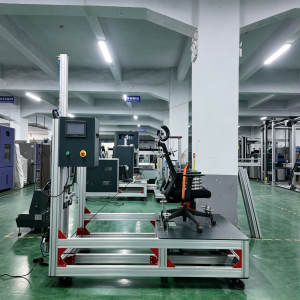
The Office Chair Backrest Repeated Loading Testing Machine is designed to simulate these conditions in a controlled laboratory environment. It helps manufacturers and testing laboratories evaluate the durability of office chair backrests and reclining mechanisms under repeated loading.
What Is an Office Chair Backrest Repeated Loading Tester?
An Office Chair Backrest Repeated Loading Tester is a furniture testing machine used to apply repeated rearward loads to a chair backrest.
The test simulates conditions that may occur during:
- Normal chair use
- Repeated reclining
- User leaning against the backrest
- Habitual misuse
- Long-term repeated loading
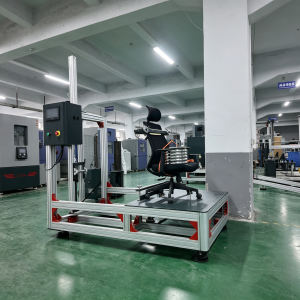
The chair is securely fixed to the testing platform, while a pneumatic loading system applies controlled force to the backrest.
By repeating the loading cycle, engineers can observe whether the backrest, reclining mechanism, connections, or other structural components show signs of deterioration or failure.
Why Test Office Chair Backrest Durability?
An office chair may appear structurally sound during a simple static load test. However, repeated loading can produce different types of stress.
During everyday use, users may repeatedly:
- Lean backward
- Change sitting posture
- Recline the chair
- Apply body weight to the backrest
- Return the backrest to its original position
These repeated actions can gradually affect the mechanical components.
Backrest fatigue testing helps manufacturers identify potential weaknesses before a chair reaches the market.
Test results can provide useful information for:
- Product development
- Structural optimization
- Material selection
- Quality control
- Durability evaluation
- Production inspection
How Does the Backrest Repeated Loading Test Work?
A typical test process includes several stages.
1. Fix the Chair
The office chair is securely positioned on the testing platform using chair fixing plates.
Stable fixation is important because unwanted chair movement could affect the test results.
2. Position the Loading Pad
A dedicated chair backrest loading pad is positioned against the backrest.
The loading position can be adjusted according to the chair design and applicable testing procedure.
3. Set the Loading Force
The pneumatic system provides the required loading force.
The equipment uses a precision manual pressure regulator, pressure sensor, and digital force display to help establish a stable test condition.
4. Apply Repeated Rearward Loading
The actuator repeatedly applies force to the backrest.
The repeated loading simulates the mechanical stress generated during long-term use.
5. Record the Test
The PLC and touchscreen control system manage the test process and display relevant test information.
If the test is interrupted by a power failure or manual stop, the system’s power-off memory and breakpoint stop functions help preserve the test status.
6. Inspect the Chair
After the specified number of cycles, the chair can be inspected for structural damage, deformation, loosening, abnormal movement, or functional changes.
Pneumatic Loading System
The testing machine uses pneumatic loading to generate repeated force on the backrest.
The supplied configuration includes:
- Load sensor: 200 kg
- Maximum output stroke: 600 mm
- Test speed: 10–30 cycles/min
- Air pressure: ≥0.5 MPa
- Air flow: ≥800 L/min
The precision pressure regulation system helps maintain stable loading conditions during the test.
PLC and Touchscreen Control
A major feature of the Office Chair Testing Machine is its automated control system.
The equipment uses PLC + touchscreen control, allowing operators to configure and monitor the test process.
The system can provide functions such as:
- Test parameter setting
- Cycle monitoring
- Force display
- Automatic operation
- Test status monitoring
- Power-off memory
- Breakpoint stop
This reduces the need for continuous manual intervention during long-duration durability tests.
Force Transmission Through a Pulley System
The machine uses a sliding fixed pulley assembly for force transmission.
The pulley mechanism provides flexibility when positioning the loading system and allows the loading position to be adjusted for different chair structures.
This is particularly useful because office chairs can vary considerably in:
- Backrest height
- Backrest angle
- Reclining mechanism
- Frame structure
- Seat dimensions
A flexible loading arrangement allows the same machine to accommodate different chair designs.
Key Technical Specifications
| Parameter | Specification |
|---|---|
| Load Sensor | 200 kg |
| Test Platform Width | 1000 mm |
| Maximum Stroke | 600 mm |
| Test Speed | 10–30 cycles/min |
| Force Control | Precision pressure regulator + pressure sensor |
| Force Display | Digital |
| Force Transmission | Sliding fixed pulley system |
| Control System | PLC + Touchscreen |
| Air Pressure | ≥0.5 MPa |
| Air Flow | ≥800 L/min |
| Power Supply | 220 VAC / 2 A |
| Machine Dimensions | Approx. 2130 × 1080 × 2200 mm |
| Machine Weight | Approx. 290 kg |
Applicable Standards
The supplied machine is designed for testing requirements associated with:
- QB/T 2280-2016
- BIFMA X5.1-2017
- EN 1335:2000
These standards cover requirements related to office and work seating, including relevant strength and durability testing.
The exact loading conditions, test cycles, and evaluation criteria should be determined according to the applicable standard and the specific chair type being tested.
What Can Be Evaluated?
A Chair Backrest Durability Tester can help evaluate several aspects of chair performance.
Backrest Structural Strength
Repeated rearward loads can reveal weaknesses in the backrest frame, joints, and supporting structures.
Reclining Mechanism Durability
For chairs with reclining functions, repeated loading can help evaluate the durability of the reclining mechanism and its connections.
Connection Reliability
Bolts, brackets, joints, and other connection points may experience repeated mechanical stress during use.
Long-Term Performance
Testing over repeated cycles provides manufacturers with data for evaluating how the chair performs under simulated long-term use.
Applications in Office Furniture Manufacturing
The equipment is particularly useful for office furniture manufacturers developing:
- Task chairs
- Computer chairs
- Executive chairs
- Ergonomic office chairs
- Conference chairs
- Commercial seating
Manufacturers can use the test results to compare different structural designs and identify potential problems during product development.
For example, engineers may modify the backrest frame, reinforcement structure, reclining mechanism, or connection components and then repeat the test to evaluate the effect of the improvement.
Backrest Testing and Product Quality Control
Durability testing is not limited to product development.
Manufacturers can also use office chair fatigue testing as part of quality-control procedures.
By applying consistent test conditions to representative samples, manufacturers can monitor product consistency and identify potential production problems.
This is particularly useful for furniture manufacturers supplying large volumes of office seating to commercial customers.
Why Automated Durability Testing Matters
Long-duration durability tests may involve thousands or more repeated loading cycles. Manual testing would be inefficient and difficult to keep consistent.
An automated furniture durability testing machine can repeatedly apply the programmed load while monitoring the test process.
The combination of:
Pneumatic Loading + Force Sensing + PLC Control + Touchscreen Monitoring
allows the testing process to be more consistent and easier to manage.
The power-off memory function is also useful for extended tests because the test status can be retained if an unexpected interruption occurs.
Conclusion
The Office Chair Backrest Repeated Loading Testing Machine provides a dedicated solution for evaluating the durability of chair backrests and reclining mechanisms under repeated rearward loading.
By simulating repeated forces that occur during everyday office chair use, the equipment can help manufacturers identify structural weaknesses, optimize product designs, and support quality-control processes.
With a 200 kg load sensor, 600 mm maximum stroke, 10–30 cycles/min adjustable test speed, pneumatic loading, PLC touchscreen control, and power-off memory, the machine is suitable for office chair manufacturers, furniture laboratories, third-party testing organizations, and product development teams.
For companies developing durable office seating, repeated loading testing provides an important bridge between laboratory simulation and long-term product performance.
Post time: Sep-17-2026


