


Introduction: The Need for Precision in Sofa Durability Testing
In the competitive furniture industry, a sofa’s long-term durability directly impacts customer satisfaction, warranty costs, and brand reputation. The Computer Sofa Integrated Test Machine is a sophisticated automated system designed to evaluate the mechanical properties of sofas—specifically the durability of the seat, backrest, and armrests. By simulating years of daily use in a controlled laboratory environment, this machine provides objective, repeatable data that helps manufacturers validate designs, ensure quality consistency, and identify weak points before products reach consumers.
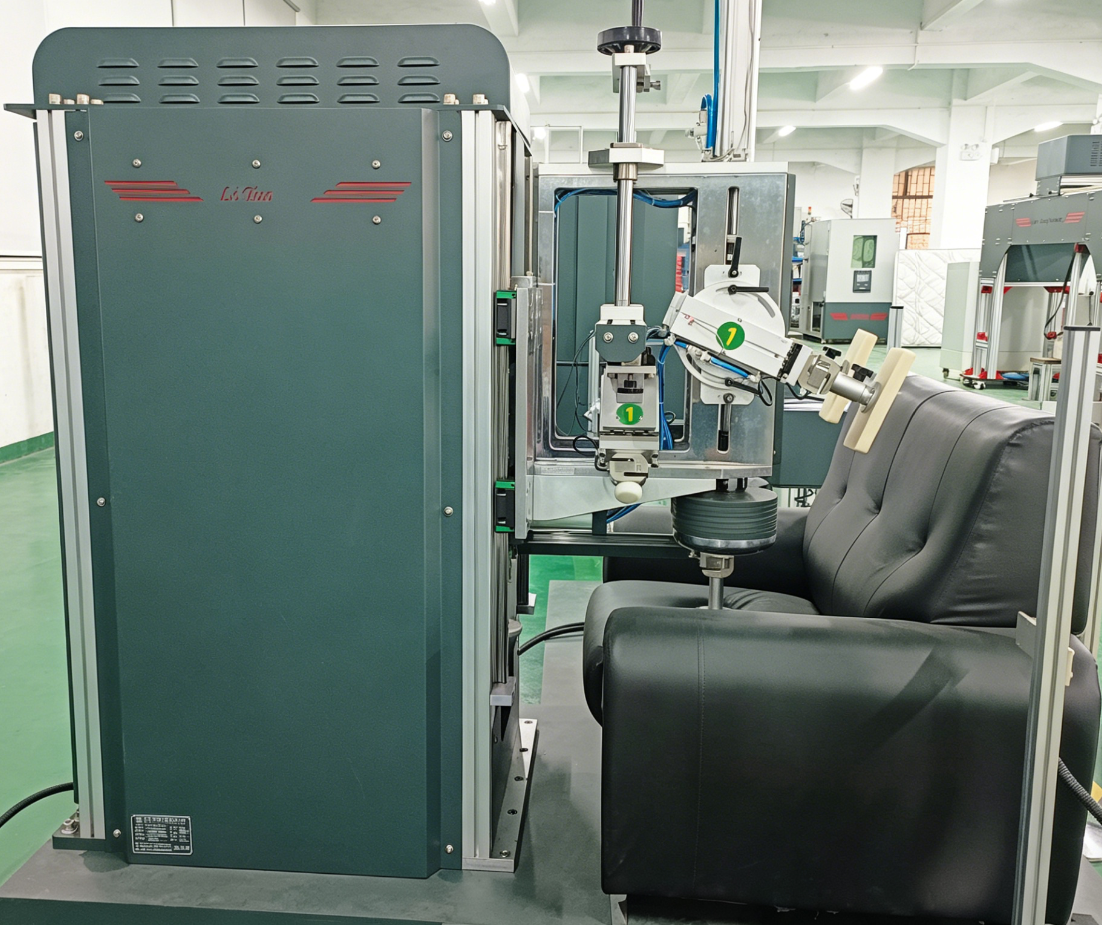
Understanding the Testing Principle: Simulating Real-World Usage
The core testing method involves applying repetitive loads to the sofa’s surfaces using shaped loading modules of specified mass and geometry. These modules mimic the contact area and pressure distribution of a human body—one for the seat (buttocks and thighs), one for the backrest (spine and shoulders), and one for each armrest (elbows and forearms). The machine actuates these modules at a defined loading frequency (e.g., 15–30 cycles per minute) and loading form (force-controlled or displacement-controlled) to simulate actions like sitting, rising, leaning, and resting arms. This accelerated test compresses months or years of typical use into days, revealing how the sofa’s cushions, springs, frames, and attachment points withstand long-term repetitive loads.
Key Components of the Integrated Test Machine
- Programmable Control System: A computer interface that allows operators to set test parameters (cycle count, frequency, load values, test sequences) and monitor real-time data.
- Servo-Actuated Loading Modules: Pneumatic or electric servo cylinders that drive shaped indenters (seat, back, armrest profiles) with precise force and stroke control.
- High-Precision Load Cells: Measure actual applied forces to ensure compliance with programmed values (accuracy ±0.5% FS).
- Automated Measurement System: Non-contact laser or LVDT sensors that automatically measure seat height, a, b, c compression values (specific deformation points), backrest offset, and armrest offset before, during, and after testing.
- Safety Enclosure & Emergency Stop: Protects operators during high-cycle testing.
Comprehensive Testing Capabilities
The computer sofa integrated test machine performs three core durability tests, either individually or in sequence, to fully characterize sofa performance.
1. Seat Durability Test (Simulated Sitting)
A buttock-shaped loading module (typically 200mm wide × 250mm deep with rounded edges) applies a programmed force (e.g., 1000N–1400N) onto the seat cushion at a set frequency (e.g., 20 cycles/min). The test runs for 20,000 to 100,000 cycles. The machine monitors:
- Seat Height Loss: Permanent reduction in cushion thickness.
- Compression Values (a, b, c): Deformation at specific force thresholds (e.g., a = 300N, b = 600N, c = 900N) to map cushion firmness and recovery.
- Frame/Suspension Integrity: Detection of spring breakage, webbing tear, or frame cracking via force-drop events.
2. Backrest Durability Test (Simulated Leaning)
A curved backrest loading module applies repetitive force (typically 300N–500N) to the back support area at a specified angle (10°–15° from vertical). The test simulates a user leaning backward repeatedly. Key measurements include:
- Backrest Offset (Permanent Deflection): How much the backrest leans back permanently after repeated loading.
- Elastic Recovery: Ability of the backrest foam and springs to return to original position.
- Attachment Point Integrity: Checking for loosening or cracking at backrest-to-frame connections.
3. Armrest Durability Test (Simulated Arm Pressure)
An arm-shaped loading module (approx. 150mm long × 70mm wide) applies vertical force (300N–600N) at a frequency of 15–20 cycles/min. The test runs 10,000–50,000 cycles. Measurements include:
- Armrest Offset (Permanent Deformation): Vertical or lateral displacement after repeated loading.
- Foam & Cover Wear: Surface cracking or permanent indentation.
- Structural Bond Integrity: Checking armrest-to-frame joints for loosening or fracture.
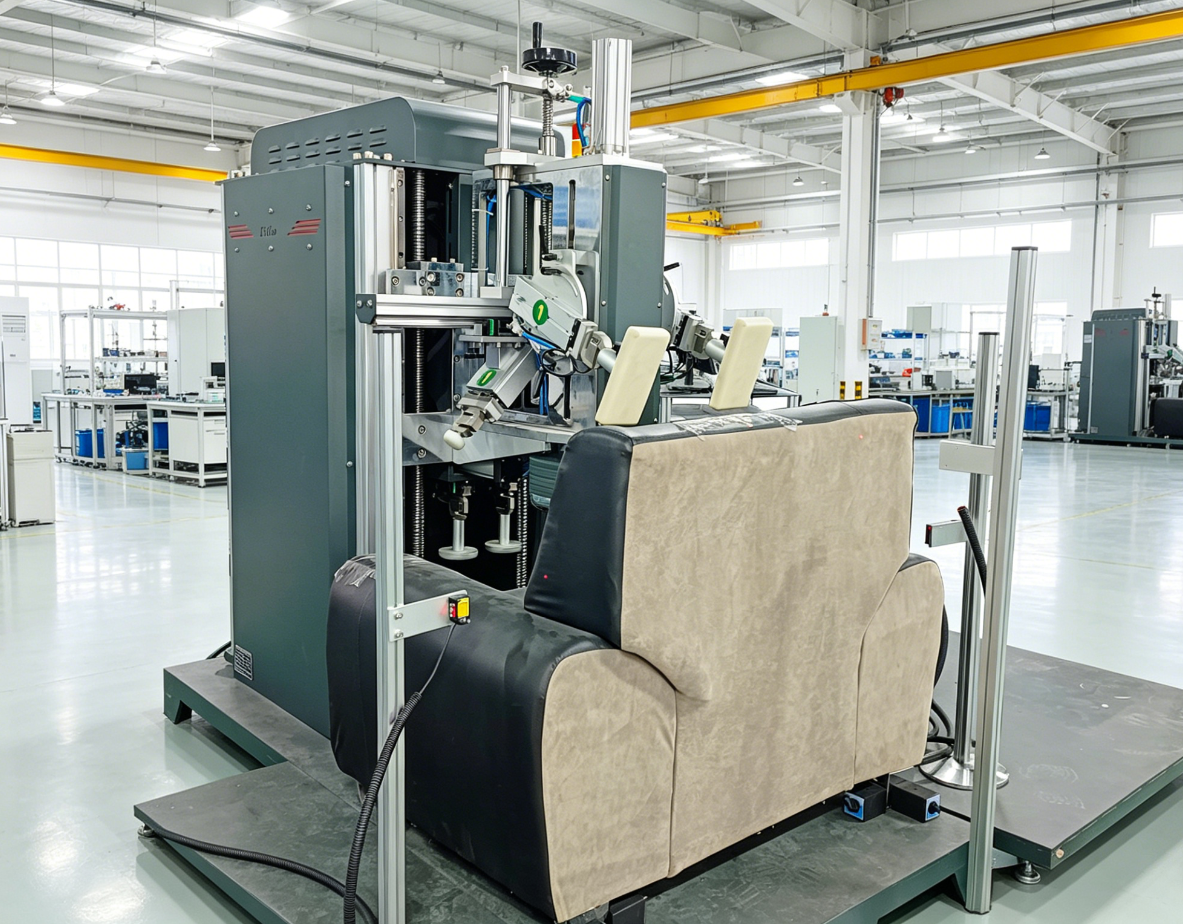
Automated Measurement: Eliminating Human Error and Saving Time
One of the machine’s standout features is its fully automated measurement system. Traditional manual testing requires operators to stop the test, manually measure seat height, mark and measure compression points (a, b, c), and record backrest/armrest offsets using rulers or dial gauges. This process is slow, prone to parallax errors, and inconsistent between operators. The computer sofa integrated test machine integrates precision sensors that automatically:
- Measure initial seat height (before any cycling) and post-test seat height to calculate permanent set.
- Record compression values a, b, c at defined force intervals during a pre-conditioning or periodic check cycle.
- Measure backrest offset (angular or linear displacement) after a set number of cycles.
- Measure armrest offset (vertical or lateral) at test completion.
This automation saves hours of technician time per test, eliminates transcription errors, and provides highly repeatable data that can be directly compared across different test runs or laboratories.
Standard Test Parameters and Protocols
While specific parameters vary by target market and product type, the following ranges are typical for sofa durability testing in compliance with standards like EN 16139, EN 12520, BIFMA X5.4, or GB/T 10357.3:
- Seat Load: 1000 N – 1400 N (approx. 100–140 kg user weight)
- Backrest Load: 300 N – 500 N
- Armrest Load: 300 N – 600 N
- Test Frequency: 10–30 cycles per minute (to avoid overheating)
- Total Cycles: 20,000 – 100,000 cycles (simulating 5–10 years of daily use)
- Acceptance Criteria: No structural failure, permanent deformation less than specified limits (e.g., seat height loss < 10%, backrest offset < 5°).
Key Benefits for Manufacturers and Test Labs
- Time Savings: Automatic measurement of seat height, a/b/c compression, and offsets reduces test duration by up to 30% compared to manual methods.
- Elimination of Human Error: Laser/displacement sensors provide consistent, objective data不受 operator technique影响.
- Comprehensive Data Logging: The computer records force-displacement curves, cycle-by-cycle trends, and final measurements, enabling root-cause analysis.
- Compliance with Global Standards: The machine can be programmed to meet EN, BIFMA, GB, and ISO test methods, simplifying certification.
- Improved Product Development: Rapid iteration of cushion foams, spring systems, and frame designs based on objective durability data.
- Quality Assurance: Regular batch testing ensures production sofas meet the same durability standards as pre-production prototypes.
Selecting the Right Machine: Key Considerations
- Number of Test Stations: Single-station machines are common for R&D; multi-station (2–4) units increase throughput for QC labs.
- Actuator Technology: Servo-electric actuators offer precise position control and energy efficiency; pneumatic actuators provide lower cost but require compressed air.
- Measurement Accuracy: Ensure the automated measurement system has resolution of 0.1mm or better for compression and offset values.
- Software Capabilities: Look for user-friendly software with pre-loaded standard test profiles, real-time graphing, and exportable reports (PDF, Excel).
- Fixture Adaptability: The machine should accommodate different sofa sizes (one-seater, two-seater, corner units) with adjustable mounting points and interchangeable loading modules.
Conclusion: The Future of Sofa Durability Testing
The Computer Sofa Integrated Test Machine represents a significant advancement over manual or semi-automated testers. By combining programmable loading (seat, back, armrest) with automated measurement (seat height, a/b/c compression, backrest/armrest offset), this equipment delivers faster, more accurate, and more repeatable results. It not only saves valuable technician time but also eliminates human measurement errors, providing manufacturers with trustworthy data to improve product quality, reduce warranty claims, and build consumer confidence. For any serious sofa producer or testing laboratory, investing in a computer-integrated test machine is a strategic move toward data-driven quality assurance.
Post time: Apr-14-2026


