


Simply put, it’s a machine that simulates a person repeatedly sitting down on a chair—tens of thousands of times.
In daily use, office chairs endure constant impact forces every time someone sits down—dozens of times a day, year after year. This machine secures the chair base and uses a standard-weight sandbag to repeatedly impact the seat surface at a set speed and frequency. It detects cushion collapse, chassis cracks, gas cylinder leaks, frame weld failures, and various other structural issues.
Human testers vary in weight, sitting force, posture, and angle—every single time. While a few test sits are fine, running 100,000 impact cycles with a human is simply impossible. And even if it were, the data would have no scientific value.
A professional seat impact testing machine offers:
- Adjustable impact height: 10–180mm or customizable
- Adjustable impact frequency: 10–30 cycles per minute
- Programmable total cycles: Up to 9,999,999 cycles
This standardized, repeatable testing is the only way to truly evaluate long-term seat durability.
A professional seat impact tester can identify multiple quality issues across different components:
- Seat cushion level: Permanent foam collapse, fabric/mesh cracking, frame glue failure
- Chassis & gas cylinder: Chassis fractures, gas cylinder leaks and sticking, loose screws causing noise
- Five-star base: Cracks in plastic/nylon/steel bases, caster mounting damage
- Overall structure: Single high-force drop impacts verify the chair’s ultimate structural strength
Repeated impact testing also frequently reveals backrest frame cracks, plastic shell breakage, hardware bracket loosening, chassis abnormal noise, and locking mechanism failure.
Cyclic impact test (durability): A 57kg (125lb) sandbag is dropped from approximately 30mm (1.2 inches) onto the seat center. The test runs at 10–30 cycles per minute for 100,000 cycles.
Single destructive impact test (functional load): A 102kg (225lb) sandbag is dropped from 152mm (6 inches) onto the seat—one single impact.
Different standards have slight variations, but BIFMA X5.1 is the most widely recognized international standard for office chair testing.
The machine supports multiple international standards:
- BIFMA X5.1 (US office furniture standard)
- ANSI/BIFMA X5.1-2017 – Clause 7 (Drop Test – Dynamic) & Clause 10.3 (Impact Test)
- GB/T 10357.3 (Chinese furniture mechanical performance standard)
- QB/T 2280-2016 (Chinese office chair standard)
- EN 1335 (European office chair standard)
- EN 1728:2012 – Section 6.24 (Seat impact test)
One machine, multiple standards—ideal for manufacturers exporting to different markets.
Modern models feature PLC touchscreen control systems with intuitive parameter setting—impact height, frequency, cycle count can all be set directly on the screen. Most machines run on standard AC220V power and do not require an external air supply, making installation quick and convenient.
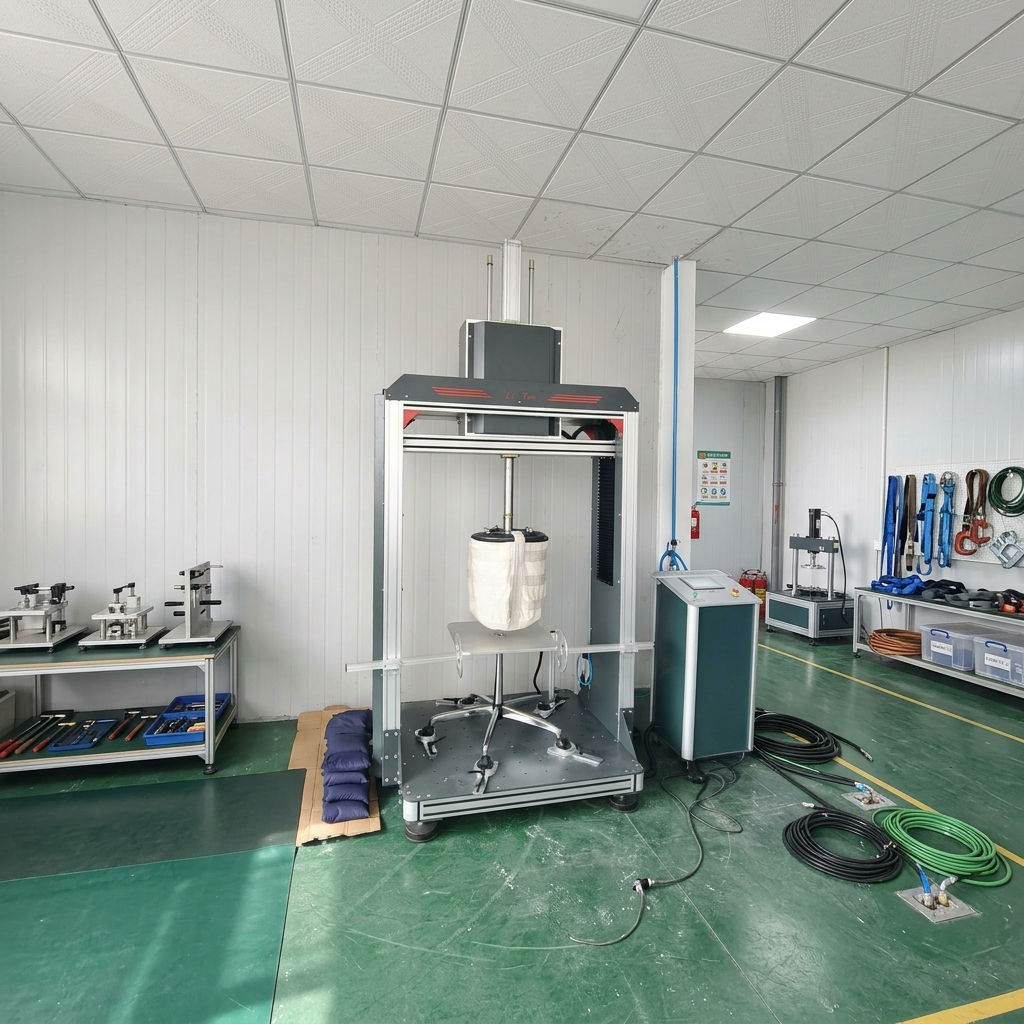
Key specifications to evaluate:
- Sandbag configuration: Standard 57kg (durability test) and 102kg (single impact test); some models also include 136kg
- Impact height range: 10–180mm or customizable, covering all standard requirements
- Impact frequency: 10–35 cycles per minute, adjustable
- Applicable seat height: Typically 350–600mm, adaptable to various chair types
- Frame rigidity: Heavy-duty steel frame ensures no deflection or shaking under long-term high-frequency impact
- Safety features: Overload shutdown, automatic cycle stop, data storage
- Office chair manufacturers: Raw material inspection, new product prototyping validation, finished product outgoing inspection
- Furniture exporters: BIFMA/EN1335 factory audits, generating compliance data
- Third-party testing laboratories: CNAS-accredited testing, contract testing services
- E-commerce quality inspection: Vendor qualification, spot-check quality audits
Seat impact is one of the highest-failure-rate test items for office chairs. A testing machine can screen out structural defects before products leave the factory, preventing expensive after-sales recalls. For export-oriented companies, without compliant test data meeting BIFMA or other standards, there’s no entry to欧美 markets.
From a cost perspective, a single batch recall costs far more than a testing machine. For any serious office chair manufacturer, this isn’t a question of “whether to buy”—it’s a question of “when.”
Post time: Aug-12-2026


