


A Two-Zone Thermal Shock Test Chamber is an important piece of environmental testing equipment used to evaluate how products and materials withstand sudden changes between high and low temperatures.
Unlike conventional temperature cycling, thermal shock testing creates a rapid transition between hot and cold environments. This accelerated test can expose defects caused by thermal expansion, thermal contraction, material stress, cracking, deformation, and component failure in a relatively short period.
It is widely used for electronic components, automotive parts, plastics, rubber products, metals, composite materials, and other products that may experience significant temperature changes during transportation, storage, or operation.
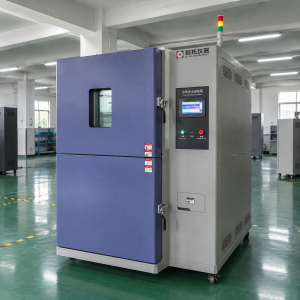
What Is a Two-Zone Thermal Shock Test Chamber?
A thermal shock test chamber consists of separate high-temperature and low-temperature zones. The test specimen is rapidly transferred between these zones according to a predefined test procedure.
For example, a typical thermal shock cycle may involve:
High Temperature → Rapid Transfer → Low Temperature → Rapid Transfer → Repeat
The rapid temperature transition places considerable thermal stress on the specimen. This makes it possible to identify weaknesses that may not be obvious during ordinary high-temperature or low-temperature testing.
The two-zone design is particularly useful when the test requires a fast transition between extreme temperatures.
Why Is Thermal Shock Testing Important?
Materials and products expand when heated and contract when cooled. When different materials or components have different coefficients of thermal expansion, repeated temperature changes can create mechanical stress at interfaces and connection points.
Over multiple cycles, this stress may cause:
- Cracks
- Delamination
- Solder joint failure
- Seal failure
- Material deformation
- Electrical connection problems
- Surface damage
- Component failure
Therefore, thermal shock testing can provide valuable information about product reliability and help manufacturers identify potential weaknesses before mass production.
High-Temperature and Low-Temperature Zones
One of the main advantages of a Two-Zone Thermal Shock Chamber is its dedicated temperature zones.
The supplied configuration provides:
- High-temperature zone: +60°C to +150°C
- Low-temperature zone: -10°C to -65°C
The system can therefore expose specimens to significant temperature differences during a thermal shock test.
Depending on the selected configuration, the chamber can also support different high- and low-temperature specifications to meet specific customer testing requirements.
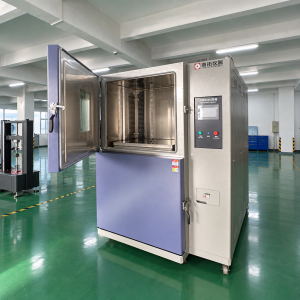
Fast Temperature Transition
Speed is one of the most important characteristics of a Temperature Shock Tester.
The supplied equipment is designed for rapid specimen transfer between the two temperature zones, with a zone conversion time of up to 10 seconds under specified conditions.
The temperature recovery time can be within 5 minutes, depending on the test conditions and configuration.
This rapid transition helps create a stronger thermal stress effect than conventional slow temperature cycling.
How Does Thermal Shock Testing Work?
A typical test process can be divided into several stages.
Step 1: Place the Specimen
The product or material is positioned in the test basket or specimen holder according to the test requirements.
Step 2: Stabilize at High Temperature
The specimen is exposed to the specified high-temperature environment until the required test condition is reached.
Step 3: Rapidly Transfer to the Cold Zone
The specimen is quickly transferred from the high-temperature zone to the low-temperature zone.
This sudden change produces thermal stress inside the specimen.
Step 4: Maintain the Low Temperature
The specimen remains in the low-temperature zone for the specified period.
Step 5: Transfer Back to the Hot Zone
The specimen is rapidly transferred back to the high-temperature zone.
Step 6: Repeat the Cycle
The high-low temperature transition is repeated for the required number of cycles.
After testing, the specimen can be inspected for physical, mechanical, electrical, or functional changes.
Two-Zone Thermal Shock vs. High Low Temperature Testing
These two types of environmental testing are related but have different purposes.
A High Low Temperature Test Chamber is generally used to maintain a product at a specified high or low temperature for a defined period.
A Thermal Shock Test Chamber, on the other hand, focuses on the rapid transition between temperature extremes.
| Test Type | Main Purpose |
|---|---|
| High Temperature Test | Evaluate performance at elevated temperature |
| Low Temperature Test | Evaluate performance under cold conditions |
| Temperature Cycling | Evaluate repeated temperature changes |
| Thermal Shock Test | Evaluate resistance to sudden temperature changes |
If the main concern is how a product reacts to rapid temperature changes, a Two-Zone Thermal Shock Test Chamber is generally more suitable than a conventional environmental chamber.
Applications of Thermal Shock Testing
Electronics and Electrical Components
Electronic products can contain multiple materials with different thermal expansion characteristics. Thermal shock testing can help identify failures in:
- Circuit boards
- Electronic components
- Sensors
- Connectors
- Displays
- Semiconductor packages
- Electrical assemblies
Automotive Components
Automotive products may experience large temperature variations during operation and storage.
Thermal shock testing can be used for components such as sensors, electrical modules, connectors, plastic components, and other vehicle parts.
Plastics and Rubber
Temperature changes can affect the flexibility, dimensional stability, and structural integrity of polymer materials.
Testing can help identify:
- Cracking
- Brittleness
- Deformation
- Shrinkage
- Loss of mechanical performance
Metal Products
Metal components can also experience thermal stress when exposed to rapid temperature changes, particularly when combined with coatings, joints, or different materials.
Composite Materials
Composite structures contain different materials that may respond differently to temperature changes. Thermal shock testing can therefore be useful for evaluating interface reliability and structural integrity.
Key Features of the Lituo Thermal Shock Test Chamber
The Lituo Two-Zone Thermal Shock Test Chamber is designed around the requirements of rapid temperature shock testing.
PID + SSR Temperature Control
The equipment uses a PID + SSR + microcomputer balanced temperature control system to provide stable and precise temperature regulation.
SUS304 Stainless Steel Construction
The chamber uses SUS304 stainless steel, providing good corrosion resistance and durability for laboratory environments.
Two-Stage Compression Refrigeration
A two-stage compression refrigeration system supports low-temperature operation.
Depending on the equipment configuration, the refrigeration system can use either water cooling or air cooling.
Comprehensive Safety Protection
The system includes multiple protection functions, such as:
- Circuit breaker protection
- Compressor high/low-pressure protection
- Refrigerant high-pressure protection
- Fault warning system
These functions help improve equipment reliability and operational safety.
Applicable Testing Standards
The supplied configuration references several Chinese national and military standards, including:
- GJB 150.5A-2009 — Temperature Shock Test
- GB/T 2424.13-2002 — Temperature Shock Test
- GJB 360B-2009 — Temperature Shock Test
- GB/T 2423.2-2008 — High Temperature Test
- GB/T 2423.1-2008 / IEC 60068-2-1:2007 — Low Temperature Test
- GB/T 10589-2008 — Technical Conditions for Low Temperature Test Chambers
- GB/T 11158-2008 — Technical Conditions for High Temperature Test Chambers
The exact standard and test procedure should be selected according to the product type, customer requirements, and applicable industry regulations.
How to Choose a Thermal Shock Test Chamber
When purchasing a Thermal Shock Testing Machine, buyers should consider several important factors.
1. Temperature Range
Determine the required high and low temperature limits first.
For example, a laboratory may require:
- +150°C / -45°C
- +150°C / -65°C
The required range will affect the refrigeration and heating system configuration.
2. Transfer Time
If the purpose of the test is to simulate severe thermal shock, rapid specimen transfer is particularly important.
A shorter transfer time generally creates a more significant temperature transition effect.
3. Temperature Recovery
After the specimen enters a new temperature zone, the chamber needs to recover to the specified test condition quickly and consistently.
4. Test Volume
The chamber size should be selected according to the dimensions and quantity of the specimens being tested.
5. Cooling System
Depending on laboratory conditions and equipment specifications, users may choose air-cooled or water-cooled refrigeration systems.
Conclusion
A Two-Zone Thermal Shock Test Chamber provides an efficient way to evaluate product reliability under sudden high- and low-temperature changes. By rapidly moving specimens between separate temperature zones, it can accelerate the thermal stress process and reveal defects such as cracking, deformation, delamination, and component failure.
For manufacturers, R&D departments, and testing laboratories, thermal shock testing is an important tool for improving product reliability and identifying potential failures before products reach the market.
With a wide temperature range, rapid zone conversion, PID-based temperature control, SUS304 stainless steel construction, two-stage refrigeration, and multiple safety protection functions, the Two-Zone Thermal Shock Test Chamber is suitable for demanding environmental reliability testing across electronics, automotive, plastics, rubber, metal, composite, and other industries.
Post time: Sep-14-2026


